
Conversation Hearts
With Valentine’s Day coming up, you can show your love in a bunch of different ways – a dozen red roses, a heart-shaped box of chocolates, a home-cooked meal, a candlelight dinner night out, a love letter (not email!!), or a classic gesture, a little sweeter … a box of Sweethearts conversation hearts. These classic treats are the only ones to state right on the candy how much you adore that special person in your life, sharing simple messages such as “Kiss Me,” “Be Mine”, “Love U,” and more with your valentine. I still remember as a kid having these candies around the house and at school (they sort of taste like sweet chalk). My girls would bring them home from school, organize them by saying and color, and then begin trading! My grandkids enjoy looking through the bowl for just the right one, running over to say “hey Grandpa”, showing me what they found, then quickly eating it while running away giggling. Of course, I need to do the same while adding chasing, yelling, and tickling to the mix! Originating in the mid-19th century, these little “messages” remain one of the most popular ways to share a Valentine’s Day “kiss”. Here is some history and facts about the candies, and the meaning behind signing cards with “XOXO”. SMOOOCH – Enjoy!
See how they are made
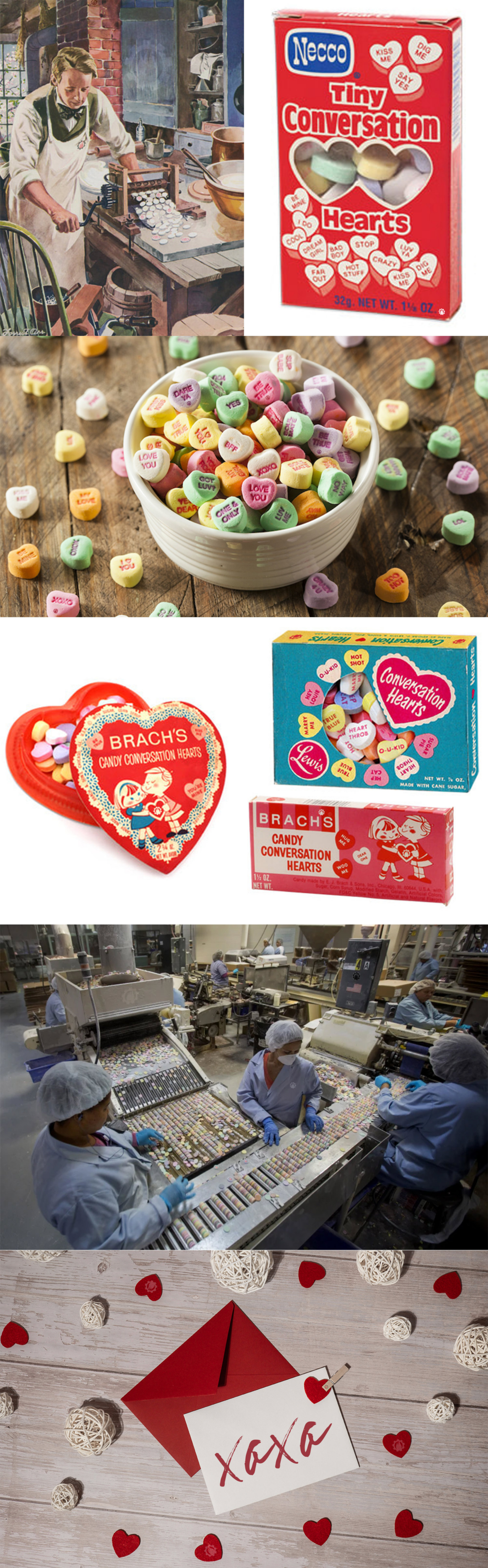
- In 1847, a pharmacist named Oliver R. Chase invented a machine to make cutting lozenges more efficient. The clove-and cinnamon-flavored treats, containing tons of sugar to mask the taste of medicine, were a big hit.
- Eventually, the pharmacist cut out the medicine and started Chase and Company with his brothers to sell candy only. The Chases conceived of new ways to market their products, including hand-printing messages on each lozenge (drawing inspiration from a British candy called “cockles” which contained paper sayings tucked inside each one.
- In 1866, Daniel Chase developed a machine that made the printing process more efficient, using a felt roller pad and some vegetable dye to imprint messages on the candy. Around 1901, Chase and Company merged with several other candy companies to create the New England Confectionary Company — or Necco, (now you know!!) as it was known throughout the 20th century.
- Messages were initially printed onto candies of various shapes, such as a scallop shell, a baseball, and a horseshoe. In 1902, the iconic heart-shaped variety made its debut. The earliest hearts were larger than the dime-size ones available today, with plenty of space for relationship advice. Examples of these early hearts read: “Married in White, you have chosen right” and “Married in Pink, he’ll take to drink.” That type of advice disappeared as the hearts shrank in size, but shorter phrases from that era are still around today, including “Be Mine” and “Kiss Me.”
- In a 2011 interview with TIME magazine, Necco marketing director Aimee Scott talked about how the company tried to incorporate a novel candy heart theme every year, adding in new phrases and carrying over some old ones. Scott claimed they “keep about 30 to 35 of the older ones” and “try to have about 20 new sayings,” which was largely dependent on popular flirtatious terminology at any given time.
- NECCO’s production lines once turned out nearly 100,000 pounds of hearts per day just to meet the February rush. Their chalky texture, created through candy-compression rather than melted sugar, is a quirky signature that inspires both devotion and debate.
- When NECCO closed in 2018, many feared the hearts would vanish for good, but Spangler Candy Company stepped in, reviving the beloved brand. Though their first batches famously arrived with smudged or missing words, affectionately dubbed “Lost Words” by fans, Spangler continues to refresh the messages each year, adding emoji hearts, “DM Me,” “Bestie,” and other modern phrases to speak the language of today’s young romantics.
- Conversation hearts also have global cousins. In the U.K., Swizzels’ “Love Hearts” have been popular since the 1950s with tangy flavors and uplifting sayings. Some European and Latin American Valentine candies offer similar short messages, though few have reached the cultural status of the American Sweethearts.
Conversation hearts tap into something universal: our fondness for tiny, thoughtful messages. Like fortune cookies or quick emojis, they deliver sweetness in just a few words. They’re playful, charming, and wonderfully low-pressure – a small way to say “I’m thinking of you.” Whether they win your taste buds or not, their ability to spark smiles has made them a Valentine’s classic for more than a century.
And Why Does ‘XOXO’ Mean ‘Kisses and Hugs’?
If you’ve ever sent a love note, or Valentine, or seen this on a conversation heart, you’ve likely also signed it with your name and “XOXO”. While nothing beats giving a big bear hug and a sloppy smooch to your sweetheart, it’s challenging to convey your affection in a card. Ending a love letter with “XOXO” means “kisses and hugs” (I am sure my wife Jackie gets it!).
- Before the “X” stood for kisses, it was a representation of identity. In medieval times, much of the population couldn’t read or write their name. If someone couldn’t sign their name, it was common to sign important documents with an “X” or a similarly shaped cross symbol. The majority of English speakers were devout Christians who believed that “X” represented the sign of the cross and Christ. Signing a document with “X” implied a sense of sincerity and fidelity.
- How “X” came to develop an explicitly romantic connotation is less clear, though there are many theories. Marcel Danesi, author of The History of the Kiss! suggests that the transition may have been an act of secular rebellion among those who used it to say, “You can’t tell me who I should marry.” Researcher Stephen Goranson suggests that it’s simpler, and that the “X” likely meant “blessings,” which in time evolved to “kiss.” It also may have to do with the letter’s shape, as some think “X” looks like puckered lips.(ok, stare at X … see the lips on each side!! > <)
- There are even fewer concrete ties linking “O” to “hugs.” Dictionary.com suggests a possibility that the first people to use “O” in contrast to “X” may have been illiterate Jewish immigrants to the United States, who signed documents with an “O” to differentiate from the Christian “X.” So while “X” evolved to mean “kiss,” “O” might have evolved in tandem to mean “hug,” given that aforementioned connection. Another theory relates to the shape of the letter, as “O” looks like a pair of encircled arms.
- While there’s no 100% verified backstory, using “XOXO” as an affectionate message meaning “kisses and hugs” became popular by the 1960s. It’s mainly an Americanism, as over in England you’re far more likely to see “XX, or double kisses, as a romantic sign-off.
How did you do on last week’s logo contest?
Check out our logo guide for the “Winter Words” post here!




Leave a Reply
Want to join the discussion?Feel free to contribute!