
In Full Bloom
Over the past few months, I’ve really enjoyed the bulb flowers that Jackie cares for during the winter season. We’ve had nice blooms from our cactus and holiday plants, especially Amaryllis– some around Thanksgiving, some around Christmas, and some into the new year. I’m fascinated by how they seem to sit dormant, and then “pop” with brilliant colors and cool shapes. As spring is approaching (hurry up!), I’m anxious for our lawn and gardens to come alive and start to bloom. (I forget what’s been planted and then smile when I see newer bulbs popping). Looking at the plants, it got me thinking about how bulbs are managed, cultivated, and shipped, and I found out it’s a highly specialized industry that blends agriculture, logistics, history, science, and global distribution – with roots (get it!) both in ancient and modern times. Today, the tradition relies on amazing, advanced technology, strict quality control, massive farms, really cool specialized machines, and scheduled shipping networks. Here’s an overview of the industry and fun facts I think you’ll like. Thanks to Wikipedia, YouTube, and Google for the info. Enjoy!
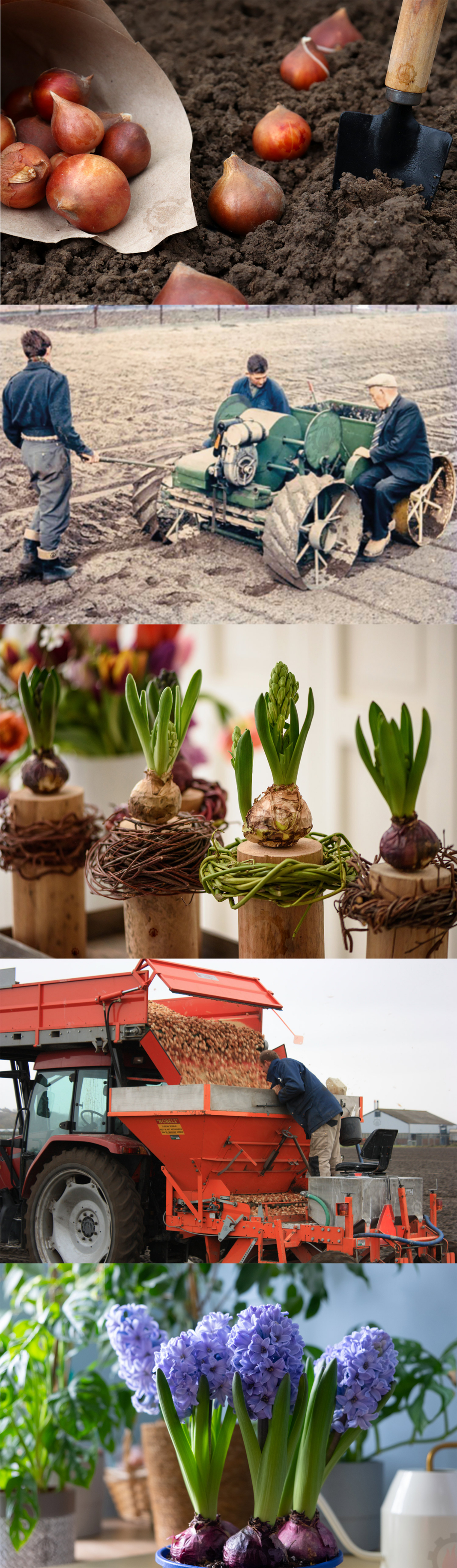
In horticultural terms, a bulb is a type of underground storage organ known as a geophyte. It allows a plant to survive unfavorable conditions like winter cold or summer drought by storing nutrients below the soil. Popular bulb flowers include tulips, daffodils, hyacinths, crocuses, lilies, and alliums. It has a short underground stem with fleshy leaves or leaf bases that function as food storage organs during dormancy. In gardening, plants with other kinds of storage organs are also called ornamental bulbous plants or just bulbs.
Unlike seeds, bulbs already contain the embryonic plant and the food it needs to grow. This makes them reliable, predictable, and commercially valuable. A healthy bulb planted at the right time almost guarantees a flower.
Most bulbs we use today come from the Netherlands, considered the center of the global bulb industry. Thanks to its sandy soils, cool maritime climate, and centuries of expertise, the region produces and exports the majority of the world’s flower bulbs. Entire areas of the country are dedicated to bulb cultivation, with fields engineered for drainage, spacing, and mechanized planting and harvesting.
The United States also grows bulbs, particularly in the Pacific Northwest, where conditions mirror parts of northern Europe. Still, most bulbs sold in the U.S. are imported, primarily from Dutch growers. Smaller but important producers include Canada, Israel, France, the UK, Poland, and Japan.
For spring-flowering bulbs, planting begins in the fall. Growers typically plant between October and November, once soil temperatures drop but before the ground freezes.
After planting, bulbs focus first on root development. Little visible activity occurs above ground, but below the surface, the plant is preparing for spring. Once winter arrives, growth pauses and the bulb enters dormancy. As temperatures rise in late winter, foliage emerges, followed by flowers. In commercial bulb production, growers often remove the flower heads shortly after blooming. This practice, called “heading,” redirects energy back into the bulb, increasing its size and future value. Many manufacturing centers bring the bulbs indoors to better control the growing process.
Specialized machinery lifts bulbs from the soil, often separating them from surrounding debris in one pass. The fields quickly shift from vibrant green to bare earth, hiding the next year’s crop already underway.
After harvest, bulbs go through a curing process. They are dried under controlled conditions to prevent rot and disease, allowing them to be stored safely for months. Roots and excess outer layers are removed, and bulbs are cleaned for inspection. Bulbs are then graded by size and quality. Larger bulbs command higher prices because they reliably produce stronger flowers. Smaller bulblets are not wasted — they are replanted and grown for future seasons, sometimes taking several years to reach market size.
Before shipping, bulbs are inspected for disease and defects., Many are pre-cooled to ensure they remain dormant during transit, especially when shipping to warmer climates. Most international bulb shipments occur between August and December. This schedule aligns with fall planting seasons around the world.
The flower bulb trade represents hundreds of millions of dollars annually. Many bulb companies are family-owned operations that span generations – a balance of small regional growers to huge operations. Knowledge is passed down through decades of trial, error, and refinement. At the same time, breeders continuously develop new varieties with improved colors, disease resistance, and climate adaptability.
No discussion of flower bulbs is complete without mentioning tulip mania. In the 1630s, rare tulip bulbs in the Netherlands became objects of intense speculation. Some bulbs reportedly sold for more than ten times a skilled worker’s annual income.
The global flower bulb trade (including tulips, hyacinths, narcissus, and other bulbs) is substantial, with estimates of billions of units traded annually. One industry overview suggests that around 2.8 – 3.5 billion flower bulbs are shipped worldwide, valued at about USD 4.2 billion in recent years. In the Netherlands alone, roughly 8.5 billion bulbs are grown annually (yikes!), dominating global bulb trade, accounting for ~85 % of international flower bulb exports and around 60 % of total global flower bulb production.
The U.S. is one of the largest importers of flower bulbs globally, with billions of units imported annually for ornamental, cut flowers, and landscaping use. Other leading importers include China, Germany, and the UK, where consumer demand is highest, importing over 1.5 billion units valued at roughly USD 2.1 billion in bulbs.
So, as winter turns to spring, enjoy the magic of the bulbs coming to life. And send me any photos of your gardens – love to see them! (skowalski@khtheat.com)
How did you do on last week’s logo contest?
Check out our logo guide for the “Test Time in the 1800s” post here!




Leave a Reply
Want to join the discussion?Feel free to contribute!