
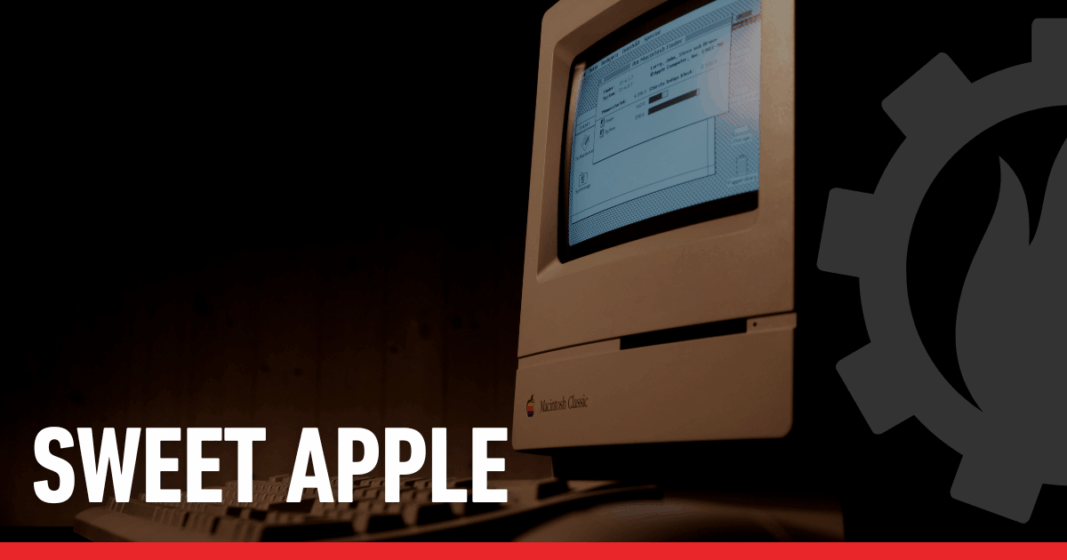
Sweet Apple
For those of you who are “in the market”, you know how fun it’s been to be on the right side of investment picks. As the tech industries continue to amaze us, I noticed that on this day in 1980, Apple Computer went public at $22 a share, raising more than $100 million in what was, at the time, the largest IPO since Ford Motor Company in 1956. The initial investors had no idea what was to come, but on “day one,” they instantly created hundreds of millionaires and marked the beginning of one of the most remarkable corporate journeys in modern history (split-adjusted price was about .10/share – worth about $60K today – WOW!) Researching and reading about the company, like many entrepreneur journeys, Apple’s rise was never a straight climb. Behind the amazing breakthrough products lies a story of perseverance through failure, reinvention in the face of near collapse, and an unyielding drive to create something better… not just for consumers, but for the world. It wasn’t just money or luck that got them going and growing – it was ingenuity. Founder Steve Jobs saw potential where others saw a toy, and Steve Wozniak was simply a genius, engineering functionality out of chaos. I thought it would be fun to go back in history and see the “little things” that happened during the first 10 years as they were forming the company. Here’s what I pulled together from the early days. I left many of the “links” for you to dive deeper. ENJOY!

Steve Jobs and Steve Wozniak, referred to collectively as “the two Steves”, first met in mid-1971, when their mutual friend Bill Fernandez introduced then 21-year-old Wozniak to 16-year-old Jobs (16 !!! ). Their first business partnership began in the fall of that year when Wozniak, a self-educated electronics engineer, read an article in Esquire magazine that described a device that could place free long-distance phone calls by emitting specific tone chirps.
Wozniak started to build his original phone called “blue boxes”, which he tested by calling the Vatican City pretending to be Henry Kissinger, asking to speak to the Pope. Jobs managed to sell some two hundred blue boxes for $150 each and split the profit with Wozniak. Jobs later told his biographer that if it hadn’t been for Wozniak’s blue boxes, “there wouldn’t have been an Apple.
By 1972, Jobs had withdrawn from Reed College and Wozniak from UC Berkeley. Wozniak designed a video terminal that he could use to log on to the minicomputers at Call Computer.
In 1975, the two Steves started attending meetings of the Homebrew Computer Club. New microcomputers such as the Altair 8800 and the IMSAI 8080 inspired Wozniak to build a microprocessor into his video terminal circuit to make a complete computer. At the time, the only microcomputer CPUs generally available were the $179 Intel 8080 (equivalent to about $1,100 today), and the $170 Motorola 6800 (equivalent to about $1,000 today). Wozniak preferred the 6800, but both were out of his price range. So, he watched, and learned, and designed computers on paper, waiting for the day he could afford a CPU.
When MOS Technology released its $20 (equivalent to $115 today) 6502 chip in 1976, Wozniak wrote a version of BASIC for it, then began to design a computer for it to run on. Wozniak’s earlier 6800 paper-computer needed only minor changes to run on the new chip.
By March 1, 1976, Wozniak completed the machine and took it to a Homebrew Computer Club meeting to show it off. When Jobs saw Wozniak’s computer, which later became the Apple I, he was immediately interested in its commercial potential. Initially, Wozniak intended to share schematics of the machine for free, but Jobs insisted that they should instead build and sell bare printed circuit boards for the computer.
Wozniak originally offered the design to Hewlett-Packard (HP), where he worked at the time, but was denied by the company on five occasions. Jobs eventually convinced Wozniak to go into business together and start a new company of their own. In order to raise the money they needed to produce the first batch of printed circuit boards, Jobs sold his Volkswagen Type 2 minibus for $1,500, and Wozniak his HP-65 programmable calculator for $500.
On April 1, 1976, the Apple Computer Company was founded by the two Steves and their friend and Ronald Wayne, who worked at Atari, Inc. as a chief draftsman. Wayne became a co-founder in return for a 10% stake, but was gun-shy due to the failure of his own venture four years earlier. On April 12, less than two weeks after the company’s formation, Wayne left Apple, selling his 10% share back to the two Steves for $800 (Ooops!). Imagine what 10% would be worth today… (about $400 billion!)
According to Wozniak, Jobs proposed the name “Apple Computer” when he had just come back from Robert Friedland‘s All-One Farm in Oregon. Jobs told Walter Isaacson that he was “on one of my fruitarian diets” when he conceived of the name and thought “it sounded fun, spirited and not intimidating … plus, it would get us ahead of Atari in the phone book (always marketing!).
Together, the two Steves made a last trip to the Homebrew Computer Club and demonstrated the Apple I (AKA: The Apple Computer). Paul Terrell, who operated the computer store chain Byte Shop, was impressed and gave them his card, asking them to keep in touch. The next day, Jobs visited Terrell at the Mountain View Byte Shop store and tried to sell him the bare circuit boards for the Apple I. Terrell said he was only interested in purchasing the machine fully assembled, and that he would order 50 assembled computers and pay US$500 each on delivery. Jobs took the purchase order from the Byte Shop to the national electronic parts distributor Cramer Electronics and ordered the components needed. When asked by the credit manager how he would pay for the parts, Jobs replied, “I have this purchase order from the Byte Shop chain of computer stores for 50 of my computers, and the payment terms are cash on delivery. If you give me the parts on net 30-day terms, I can build and deliver the computers in that time frame, collect my money from Terrell at the Byte Shop, and pay you.”
To verify the purchase order, the credit manager called Paul Terrell, who assured him that if the computers showed up, Jobs would have more than enough money for the parts order. The two Steves and their small crew spent day and night building and testing the computers and delivered them to Terrell on time. Terrell was surprised to receive a batch of assembled circuit boards, as he had expected complete computers with a case, monitor, and keyboard. Nonetheless, he kept his word and paid them the money promised.
The Apple I went on sale in July 1976 as an assembled circuit board with a retail price of $666.66. Wozniak later said he had had no idea about the relation between the number and the mark of the beast, and that he came up with the price because he liked repeating digits. About 200 units of the Apple I computers were eventually sold.
Jobs looked for investments to expand the business, but banks were reluctant to lend him money; the idea of a computer for ordinary people seemed absurd at the time. In August 1976, Jobs approached his former boss at Atari, Nolan Bushnell, who recommended that he meet with Don Valentine, the founder of Sequoia Capital. Valentine was not interested in funding Apple, but in turn introduced Jobs to Mike Markkula, a millionaire who had worked under him at Fairchild Semiconductor. Markkula saw great potential in the two Steves and became an angel investor of their company, investing $92,000 in Apple out of his own property while securing a $250,000 (equivalent to $1,380,000 in 2024) line of credit from Bank of America. In return, Markkula received a one-third stake in Apple. Apple Computer, Inc. was incorporated on January 3, 1977. The new corporation bought out the partnership the two Steves had formed nine months earlier.
In February 1977, Markkula recruited Michael Scott from National Semiconductor to serve as the first president and CEO of Apple Computer, as the two Steves were both insufficiently experienced, and he was not interested in taking that position himself. That same month, Wozniak resigned from his job at Hewlett-Packard to work full-time for Apple.
Almost as soon as Apple had started selling its first computers, Wozniak moved on from the Apple I and began designing a greatly improved computer: the Apple II. Wozniak completed a working prototype of the new machine by August 1976, and the two Steves presented the Apple II computer to the public at the first West Coast Computer Faire on April 16 and 17, 1977. On the first day of the exhibition, Jobs introduced the Apple II to a Japanese chemist named Toshio Mizushima, who became the first authorized Apple dealer in Japan. In the May 1977 issue of Byte, Wozniak said of the Apple II design, “To me, a personal computer should be small, reliable, convenient to use, and inexpensive.”
The Apple II went on sale on June 10, 1977, with a retail price of $1,298. During the development of the Apple II, Jobs pressed for a well-designed plastic case and built-in keyboard, with the idea that the machine should be fully packaged and ready to run out of the box. It was one of the three “1977 Trinity” computers generally credited with creating the home computer market (the other two being the Commodore PET and the Tandy Corporation TRS-80). The Apple II series went on to sell about six million units in total before it was discontinued in 1993. I can remember purchasing our first PC here at KHT – Apple IIe with a whopping 512 RAM – remember the floppy discs!
Of course, the Apple management was not content and developed the Apple III, designed to take on the business environment in an attempt to compete with IBM. The development of the Apple III started in late 1978 under the guidance of Wendell Sander and was subsequently developed by a committee headed by Jobs, with a retail price ranging from $4,340 to $7,800, and released in November 1980.
The Apple III was a conservative design for the era; however, Jobs wanted the heat generated by the electronics to be dissipated through the chassis of the machine rather than by the more usual cooling fan. The case was not sufficient to cool the components, and the Apple III was prone to overheating, causing the integrated circuit chips to disconnect from the motherboard. Customers who contacted Apple customer service were told to raise their computers into the air and then let go to cause the integrated circuits to fall back into place.
On December 12, 1980, Apple went public on the NASDAQ stock exchange with the ticker symbol “AAPL”, selling 4.6 million shares at $22 per share ($.10 per share when adjusting for stock splits as of November 30, 2020), generating over $100 million, which was more capital than any IPO since Ford Motor Company in 1956. Several venture capitalists immediately cashed out, reaping billions in long-term capital gains. By the end of the day, the stock rose to $29 per share, and 300 millionaires were created, including the two Steves. Around this time, Wozniak offered $10 million of his own stock to early Apple employees, something Jobs refused to do. Apple’s market cap was $1.778 billion at the end of its first day of trading – that’s crazy!
In January 1981, Apple held its first shareholders meeting as a public company in the Flint Center, a large auditorium at nearby De Anza College (which is often used for symphony concerts), to handle the larger number of shareholders post-IPO. The business of the meeting had been planned so that the voting could be staged in 15 minutes or less. In most cases, voting proxies are collected by mail and counted days or months before a meeting. In this case, after the IPO, many shares were in new hands.
Jobs started his prepared speech, but after being interrupted by voting several times, he dropped his prepared speech and delivered a long, emotionally charged talk about betrayal, lack of respect, and related topics. He went on to talk of the potential of computers, referring to them as “the bicycle of the mind”. See personal interview here.
All of this excitement in the first 10 years! Perhaps I’ll revisit the next 10 years sometime in the future.
How did you do on last week’s logo contest?
Check out our logo guide for the “Calm in the Chaos” post here!




Leave a Reply
Want to join the discussion?Feel free to contribute!