

The @ Symbol
Here at KHT, we operate around a driving principle – namely an obsession to tackle and solve your PIA (Pain in the @%$) Jobs! As I was typing this in an email to a potential customer, it struck me that we’ve used the “@” symbol in our promise for decades, to help us communicate not just what many of our customers feel (more fun than aaarrrggghhh!) but also what makes us tick as a thermal processing service provider to so many industries (thanks Dad for supporting me as we pursued this!!). Being the curious type, I jumped onto the internet and found a whole bunch of fun info on early text symbols, and fun 🙂 symbols called emoticons. Teaser – the @ symbol was invented more than 400 years before email! Here’s some really great info about text symbols, along with some of my favorite emoticons. I wasn’t able to find an emoticon that reflects my kids rolling their eyes! Enjoy! – or should I say { ^.^ }
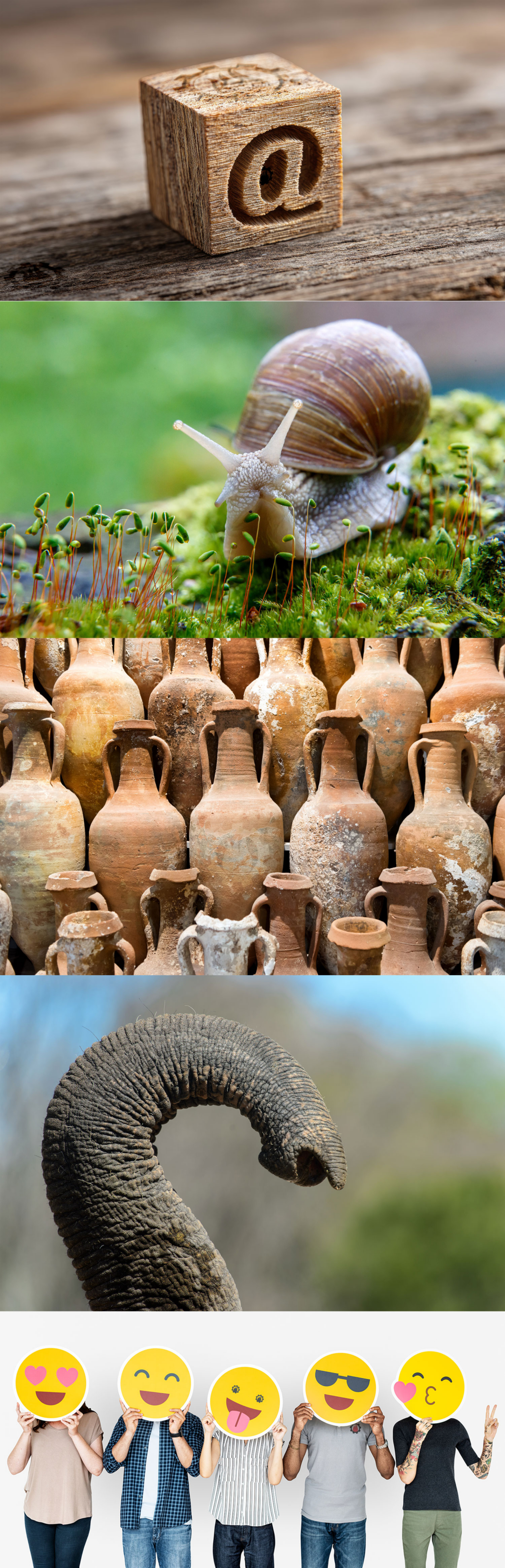
The @ symbol has been in use for centuries, long before digital communication made it one of the most-typed characters on Earth. The first documented use dates back to a 1536 letter written by an Italian merchant, who used a looping “a” as shorthand for amphorae (https://en.wikipedia.org/wiki/Amphora ) – a traditional unit of volume roughly equal to a standard clay amphora jar.
In other contexts, medieval scribes used the symbol to mean “at the rate of,” a simple flourish that made bookkeeping more efficient. As global trade expanded, merchants began using @ in ledgers to indicate cost per unit — for example, three barrels @ five florins each. This practical function kept the symbol alive even as writing styles, currencies, and languages changed.
For centuries, @ was a quiet workhorse of accounting and business writing. Most people only saw it on invoices or typewriter keys. Before keyboards standardized their appearance, scribes wrote @ in many shapes – tight spirals, wide loops, even shapes resembling miniature snails. The typewriter era forced a consistent design, though some early machines skipped the symbol entirely. Its presence on the Remington No. 2 typewriter in 1889 likely saved it.
Around the world, @ has collected a delightful set of nicknames. In Italy, it’s the chiocciola — the snail. In Israel, it’s the shtrudel. In Germany, it’s the Klammeraffe, the “spider monkey.” Swedes call it the “elephant’s trunk a,” while Hungarians see a worm.
That changed dramatically in 1971. Computer engineer Ray Tomlinson, creating the world’s first networked email, needed a character to separate a user’s name from a host computer. It had to be available on all keyboards, rarely used in names, and clearly meant “located at.” The humble @ symbol fits perfectly. Today, @ routes billions of messages daily and anchors our digital identities across email and social media. Not bad for a scribble invented by a bunch of merchants.
As email gave @ global relevance, social media turned it into a cultural icon. Twitter (now X) popularized using @ to tag or address other users – a practice invented by users themselves. Other platforms quickly adopted the convention, making @ the universal symbol of online identity and interaction. Today, we can’t create a handle, tag a friend, or mention a user without it.
Here are some other popular typed symbols:
The Question Mark (?) – The question mark originated with medieval monks. It evolved from the Latin word quaestio, which scribes abbreviated as “qo” and stacked vertically. Over time, the flourish of the “q” curved into the mark we know today.
Spanish writers introduced inverted punctuation marks like ¿this? in the 1750s to signal a question from the start, and writers once proposed a “rhetorical question mark.” It never gained traction, but it shows how long we’ve been tinkering with punctuation.
The Exclamation Point (!) – The exclamation point comes from the Latin word “io,” meaning joy. Monks stacked the letters vertically, eventually stylizing them into a single mark. In the early days of printing, exclamation points were expensive to create. Typesetters sometimes charged extra – a practical reason early writing looks calmer than today’s texts. And yes — the interrobang (‽), created in 1962, combines ? and ! into one glorious mark of disbelief.
The Asterisk (*) – The asterisk may be the oldest symbol on our keyboard. It dates back to ancient Greek manuscripts from the 2nd century BCE. The name comes from asteriskos, “little star,” and early versions looked like ornate flowers. Today, the asterisk does a little of everything — math, footnotes, corrections, censorship, and even internet search shortcuts.
The Birth of Emoticons 🙂 – Before emojis took over our screens, emoticons – simple faces made from punctuation were the first attempt to express emotion in text. The most widely accepted origin dates to 1982, when Scott Fahlman at Carnegie Mellon University suggested using 🙂 for jokes and 🙁 for the seriousness on early online bulletin boards. His message is still preserved today. But earlier examples keep popping up – A German transcript from 1881 uses a sideways smile. A poem from 1650 includes a winking face. Even then, people felt the need to “soften” text with a little personality.
Emoticons exploded during the 1990s and early 2000s with email, chat rooms, and instant messaging. AIM, MSN Messenger, and Yahoo! Messenger turned them into clickable icons. Western emoticons began as sideways faces like 🙂 or :-O. Meanwhile, Japanese creators invented kaomoji, upright faces with wide-eyed expressions such as (^_^) & (¬‿¬).
The first emoji set appeared in 1999, created by Japanese designer Shigetaka Kurita. It included 176 tiny icons representing faces, weather, and simple objects. Today, emoji are a full pictographic language but emoticons still survive. They feel personal, nostalgic, and charming in a way that graphics sometimes aren’t. Here are just some of my favorites … some of these make me laugh out loud when I learned what they mean.
🙂 😀 ^_^ Happy
🙁 T_T Sad
😉 Wink
:-O Surprised
¯\_(ツ)_/¯ Shrug (brilliant!)
:/ Skeptical
0:-) Angel
#-( Partied all night
*\0/* Cheerleader (brilliant!)
(*_*) Confused
(=_=) Tired
(+_+) Dazed
@%$ KHT (yeah!)
I’d love to know: Do you have a favorite symbol or emoji? Any emoticons you still use? Shoot me an email @ skowalski@khtheat.com – pretty cool how I wrapped this blog up with the use of @ 🙂
How did you do on last week’s logo contest?
Check out our logo guide for the “Conversation Hearts” post here!




Leave a Reply
Want to join the discussion?Feel free to contribute!