

Time To Step Up
Now that we’ve turned the corner on 2026, you’re likely thinking about starting the year off right with better exercise and diet. Did you know next Wednesday is National Take the Stairs Day? It’s a quirky, uplifting celebration that encourages everyone – office workers, students, and public officials alike – to skip the elevator and climb the stairs for a healthier lifestyle. For me, I’m lucky that my office is on the second floor here at KHT World headquarters (that’s fun to write!). So often during the day, I scoot down the back stairs, onto the shop floor to check on your PIA (pain in the @%$) Jobs! It’s not a long descent or climb, but it does get me out of my chair and moving. In the town I live in, I’m blessed to have stair access to Lake Erie. Jackie and I love to head over to the lakefront and make our way down to the sand and surf. I’ll admit, the walk back up does test my lungs every time I do it! I can feel it in my calves too! At first, I thought the celebration day was a bit silly, but thinking a bit more about it, it made sense to share. Here’s some fun info on the day, and more about “steps” I hope you enjoy – I sure learned a lot doing my research. Enjoy!
Stair climbing isn’t just a task; it’s a health boost. According to the American Lung Association, stair climbing improves your lung function, strengthens major muscle groups, and can help create a tobacco-free, clean-air future.
Regular stair climbing can reduce the risk of more than 40 chronic conditions, including diabetes, heart disease, high blood pressure, and even dementia. (If you want to make heart health a priority, the American Heart Association Life’s Essential 8 can be a helpful place to start.)
Stair climbing can help strengthen the heart and improve blood pressure, cholesterol, and blood sugar. Climbing one flight of stairs burns about 8–11 calories, depending on pace and body weight—meaning even quick trips at work can add up fast.
A study found that people who climb more than five flights (or 50 stair steps) a day had a 20% lower risk of developing atherosclerotic cardiovascular disease (ASCVD), which includes stroke, heart attacks, and blood clots. (However, when some participants stopped climbing stairs during the 12.5-year follow-up period, they were 32% more likely to develop ASCVD than those who never reported stair climbing in their questionnaire.) SO…………… I strongly encourage you to keep climbing!!
The Eiffel Tower staircase was once climbed by an elephant in 1948, and by a man on stilts in another stunt. There’s even a record for most stairs climbed while doing a headstand: 36! (not sure how the jump to each step??
The mostly online community for competitive stair climbing affectionately calls each other “step-brothers” and “step-sisters.”
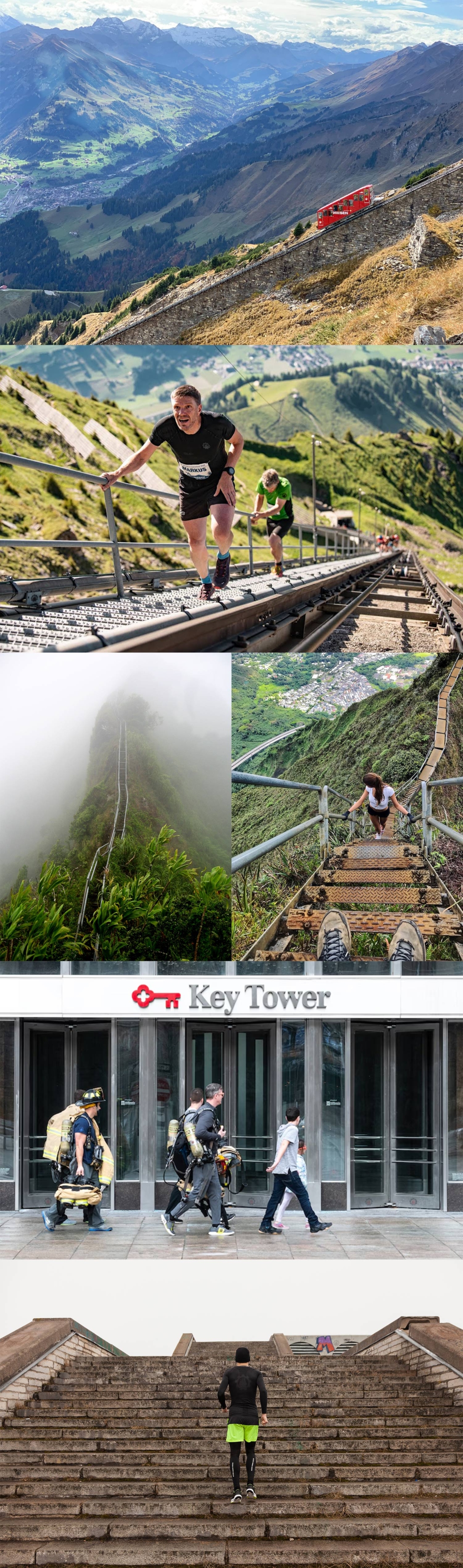
Longest staircase in the world: The Niesenbahn funicular in Switzerland has a staircase with 11,674 steps running alongside the track. It’s open to the public only once a year for a massive race.
100 Story Climb: the record was set by Dennis W. Martz in the Detroit Plaza Hotel, Detroit, Michigan, USA on 26 June 1978 at 11min 23.8sec. https://www.guinnessworldrecords.com/world-records/67877-stair-climbing-fastest-up-a-100-storey-building
Steepest staircase: The Haiku Stairs in Hawaii – also known as the “Stairway to Heaven” – include 3,922 extremely steep steps climbing along the Ko’olau mountain range. Technically closed to the public, but still legendary.
Most stairs climbed in 24 hours: German athlete Christian Riedl climbed 48,080 vertical feet in a day during a stairclimbing ultramarathon in Frankfurt.
Most skyscrapers climbed in one hour: The world stair climb record-holder, “Tower Runner” Piotr Łobodziński, can ascend more than 1,000 vertical meters in 60 minutes.
Quirkiest stair feat: The world record for most stairs climbed while juggling is 2,307; meanwhile, another record holder once climbed stairs on his hands for a full city-center race.
“Tackle the Tower” or Fight for Air Climb is a stair-climbing event at Cleveland’s Key Tower, which features 54 floors and 1,268 steps. Participants can race or walk the climb at their own pace, and the event raises money and awareness for the American Lung Association. There are different challenges available, including the “Ultimate Climb” (ascend and descend multiple times) and a “Firefighter Challenge” where first responders climb in full gear. There is also a sister Terminal Tower climb. Now this event is next held on March 1, 2026 – time for me to start training!!
How did you do on last week’s logo contest?
Check out our logo guide for the “Scoooore!” post here!




Leave a Reply
Want to join the discussion?Feel free to contribute!