
U is for Urban Utopia
When my girls were little (and now as I watch my grandchildren curl up in front of the TV), few shows have shaped their early learning quite like Sesame Street. They learned their letters and numbers there, sure. But they also absorbed something quieter and deeper: kindness, patience, cooperation, belonging, friendship, and so much more. Without realizing it very much, I read an article about how the early show designers created a magical space, introduced kids to something else just as powerful—the idea of a neighborhood where people look out for one another. For more than half a century, millions of children have learned their ABCs and 123s from this iconic show. But as it turns out, the most enduring lesson may not only be academic at all – but it may also be about community, city life, and what makes a great place to live. Jackie and I are so blessed to live in a small city – easy commutes, friendly, caring neighbors, convenient retail, and the peace of mind that comes with it. It should constantly remind all of us to strive to be a little bit nicer! Here is some cool “Sesame Street” trivia. And as the theme music tells us … “Sunny days, sweeping the clouds away …” (it’s ok, you can sing it out loud!!) Enjoy!!
Check out this video from the opening show – amazing fun from day 1.
The story begins in 1966 with Joan Ganz Cooney, a media executive fresh off an Emmy win for a documentary on the War on Poverty. At a time when television was often dismissed as a “vast wasteland,” she saw it as a powerful tool for early childhood education. Research showed that more American homes had televisions than bathtubs, telephones, or even daily newspapers. If TV has already reached nearly every child, why not use it for good?
Working alongside producer Jon Stone, Cooney set out to create a new kind of educational program. But Stone’s vision for the setting stunned the team. In 1968, while watching a public service campaign that showed children playing in Harlem’s streets, he had an epiphany: the show didn’t belong in a classroom or a fantasy land—it belonged on a real city block.
The timing could not have seemed worse. Riots, rising crime, and widespread white flight to the suburbs marked Late-1960s New York. Cities were portrayed as places to escape, not places to celebrate. Yet Stone saw exactly why a city street mattered. If the show was meant to include inner-city children and close educational gaps, it should reflect their real lives.
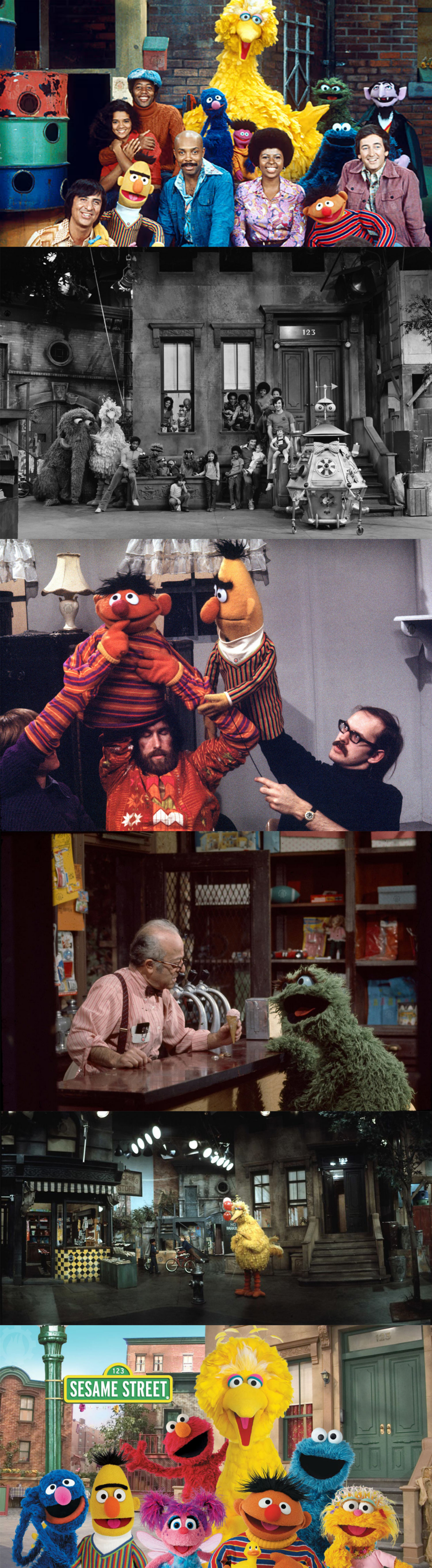
Set designers scouted Harlem, the Upper West Side, and the Bronx, creating a composite neighborhood that became 123 Sesame Street. The street wasn’t sanitized—there was litter, chipped brick, fire escapes, and real wear and tear (Oscar lived in a trash can, after all). But the show tried to replace fear with belonging. Instead of crime and chaos, the street modeled cooperation, diversity, problem-solving, and friendships.
Without ever formally naming it, the creators aligned the show with the urban philosophy of a writer named Jane Jacobs, whose landmark 1961 book The Death and Life of Great American Cities reshaped how planners thought about neighborhoods. Jacobs championed mixed-use, walkable blocks filled with life—exactly what Sesame Street portrayed. In her book, she identified four conditions that make great neighborhoods, and remarkably, the set design embodies them all:
- Multiple Functions – The street features a corner store, a laundromat, apartments, and gathering places. It’s never empty. Someone always has a reason to be there.
- Short Blocks – The design encourages constant movement and casual interactions—people bumping into each other naturally.
- A Mix of Old and New Buildings – When the set was redesigned in the 1990s, the original brownstone was intentionally retained next to newer buildings. One designer described it as “a survivor of gentrification.”
- High Density – Plenty of neighbors means “eyes on the street,” greater safety, and stronger community ties.
Jacobs famously called the resulting activity the “sidewalk ballet” (such a great name!) —those small, unplanned moments that make a place feel alive. The very first episode of Sesame Street captures this perfectly as Gordon walks newcomer Sally down the block, greeting shopkeepers, neighbors, and Big Bird along the way. Small interactions, stitched together into something powerful.
When actress Loretta Long played Susan, an African-American homeowner at 123 Sesame Street, the character quietly rewrote what children expected to see on television. “Not only were we a Black married couple, but we also owned that house,” she later wrote. “Showing Black homeownership didn’t feel radical – it felt normal. And that may have been its greatest power.”
The exterior Sesame Street set has always been a physical street built on a soundstage. Since the 1990s, it has lived at Kaufman Astoria Studios in Queens, New York. The address “123” was chosen because it symbolized early learning – numbers right at the front door.
Over the decades, the set has evolved with the times: new businesses moved in, residents changed, and even gentrification was subtly reflected – just like in real cities. For example, after the death of Hooper’s Store owner Will Lee, the show made television history by directly addressing death in a child-appropriate way instead of replacing the character.
The magic of Sesame Street isn’t just in what happens on the street—it’s in how the street comes alive. Behind every cheerful monster and friendly neighbor is a world of engineering, physical endurance, and astonishing artistry. Here’s some fun trivia:
Big Bird: The Hardest Job on the Street – For nearly 50 years, Big Bird was performed by Caroll Spinney, who literally lived inside a 12-foot-tall costume. Spinney walked by, bending his arm above his head to hold Big Bird’s beak. A tiny TV monitor inside the costume allowed him to see what was happening below eye level. On hot studio days, temperatures inside the suit could exceed 100 degrees. (Spinney also voiced and performed Oscar the Grouch—meaning he often had to switch emotionally from cheerful optimism to sarcastic grumpiness in the same production day).
Oscar the Grouch’s Trash Can Is a High-Tech Illusion – Oscar, performed for decades by Frank Oz and later others, appears to live at street level—but his trash can is actually connected to a sunken pit beneath the set. The puppeteer stands below the sidewalk inside a hidden vertical shaft, and the lid is controlled by carefully timed hand movements. The can itself is one of the most technically complicated puppets on the entire street. Despite living in a trash can, Oscar has become one of the most psychologically complex characters on children’s television—teaching kids that it’s okay to be different, even grumpy sometimes.
Bert and Ernie Were Never Meant to Be a “Pair” – The iconic duo – Bert and Ernie – were initially designed as fill-time characters between major segments. Bert is based on a serious banker-type personality, while Ernie was modeled after playful, impulsive behavior. Their odd-couple dynamic became so beloved that they evolved into permanent headliners. Despite decades of pop culture speculation, the creators always maintained that Bert and Ernie were roommates and represent complementary temperaments, teaching kids how different personalities can coexist and get along under one roof.
Elmo Was Almost Written Off the Show – Before becoming the face of the entire franchise, Elmo was a background character with no defined personality. Then puppeteer Kevin Clash gave Elmo a high-pitched voice, childlike curiosity, and gentle emotional vulnerability. Producers immediately saw the magic. By the late 1990s, Elmo became the breakout star – so popular that some educators worried he was too influential.
Cookie Monster Was Originally a Villain – Before he loved cookies, Cookie Monster appeared in early sketches as: A wheel-stealing monster, a furniture-eating creature, and even a villain selling bad snacks. His obsession with cookies evolved after researchers realized that his exaggerated behavior helped preschoolers understand self-control. Even Cookie Monster eventually learned that cookies are a “sometimes food.”
The Puppets Age – On Purpose – Unlike most TV characters frozen in time, Sesame Street allows its universe to mature: Maria aged from teenage helper to business owner, Gordon and Susan transitioned to new careers, and new families moved in as old characters retired or passed away. This quiet aging process mirrors real neighborhood turnover and teaches kids that change is part of community life.
Sesame Street Has Always Been a Testing Lab – Before episodes ever air, they undergo focus groups with real preschoolers, use attention tracking, and emotional response testing. Scenes that fail to hold attention for even seconds are revised or removed. In some of the earliest testing, children were so riveted by the Muppets that producers removed adult-only segments entirely, revolutionizing children’s television forever.
I must admit, I never get tired of watching Sesame Street – without a doubt, it puts a smile on my face every time. Come on, sing it a little … “sunny days, sweeping the clouds away.”




Leave a Reply
Want to join the discussion?Feel free to contribute!