

Wham-O & The Pluto Platter
Just the word Wham-O, and I immediately think of my childhood and fun toys – hula hoops, super balls, slip n slide, hacky sacks, and of course, frisbees. There are not many toys out there as easy, fun, and everlasting as a frisbee. Before it was a staple of college quads, picnics, beach days, and backyard games, it was actually just a pie tin. My kids and now grandkids love throwing/trying to throw the frisbees – especially AT Grandpa and Grandma!
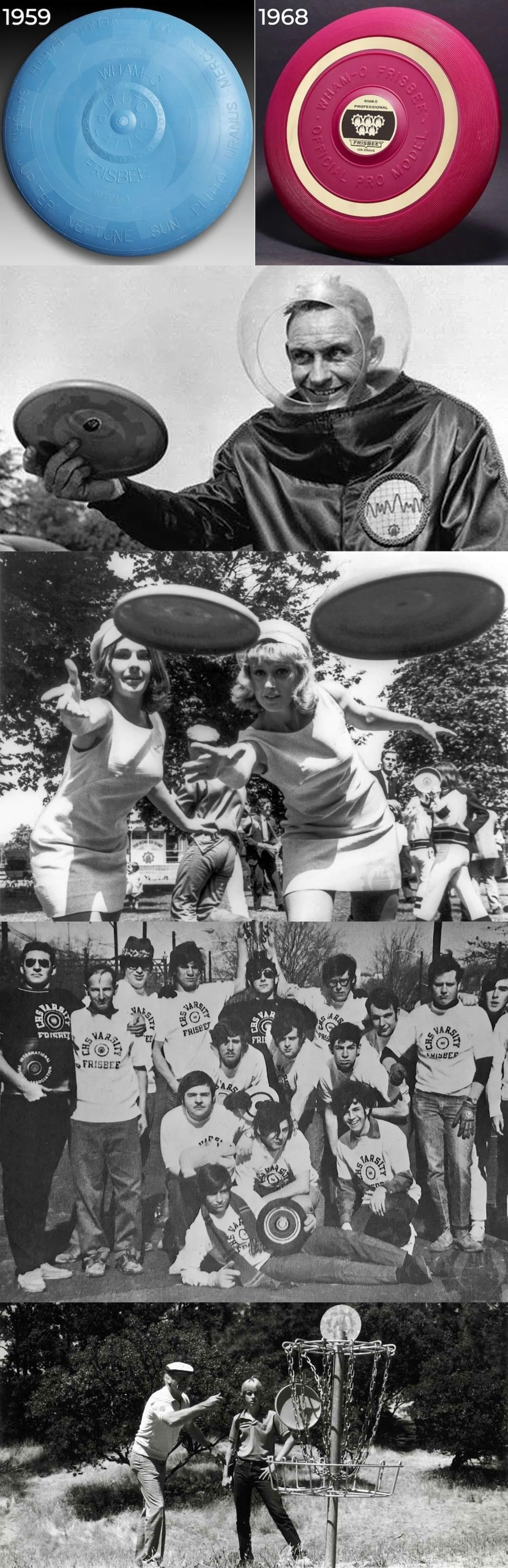
The story begins in Bridgeport, Connecticut, where William Frisbie opened the Frisbie Pie Company in 1871. Students from Yale, Harvard, and other universities would throw the empty pie tins to each other, yelling “Frisbie!” as they let go. (Wham-O later tweaked the spelling to Frisbee to avoid trademark issues.)
In the 1940s, Walter (Fred) Morrison, a WWII pilot and tinkerer, saw the potential in turning those metal tins into a safer, lighter, plastic flying toy. Working with early plastics, he developed a saucer-like disc called the Pluto Platter, named to ride the wave of 1950s space fascination with UFOs (it was recognized as a planet back then!)
The Pluto Platter featured a domed top, flared rim, and molded details meant to look “space age.” It wasn’t yet the aerodynamic masterpiece we know today – but it flew well, it was durable, and it captured imaginations.
A pivotal figure in Frisbee history is Edward “Steady Ed” Headrick, an engineer at Wham-O who redesigned the disc into the modern aerodynamic shape. He filed and received U.S. Patent 3,359,678, covering key innovations including concentric stabilizing ridges (sometimes called “the Lines of Headrick”), Re-shaped rim geometry for better glide and less wobble, and improved grip surface for consistent throwing.
This made the Frisbee fly farther, truer, and more predictably. Headrick would later go on to found the International Frisbee Association and become the father of disc golf, inventing the modern chain-and-basket target still used worldwide.
In 1957, Morrison sold his design to Wham-O, the toy giant known for the Hula-Hoop and the Super Ball. Wham-O immediately recognized they had another cultural hit on their hands. Clever marketing, youth culture, and the post-war boom in plastics combined to launch the Frisbee into American life. Within a decade, it wasn’t just a toy you tossed — it was a thing: a pastime, a competitive sport, a beachfront ritual, and the centerpiece of countless games invented on the fly (get it?!).
The First Mass-Market Frisbee Cost…$0.98. Adjusted for inflation today, that’s about $10 — not far from what a basic disc costs today.
A Frisbee is, in essence, a spinning wing – It’s simple mechanics, but it feels like magic.
For my engineers out there (and curious readers, here are the “specs” on how it flies:
- Lift: The disc’s curved shape creates pressure differences like an airplane wing, pushing it upward.
- Gyroscopic stability: Spin keeps the disc from tumbling, allowing it to maintain orientation. More spin is even better!
- Angle of attack: Tilt it slightly up, and it soars; tilt it down, and it dives. Skilled throwers manipulate this to control the flight path.
- Rim and drag: The rim holds the weight and airflow in just the right places. Modern discs intentionally balance speed, glide, and stability. And, the rims on top are not just for decoration – they reduce drag and stabilize airflow.
- Wind effects: A tailwind can add huge distance, which is why world records are often set in desert wind corridors.
Ultimate (Frisbee) was invented in 1968 at Columbia High School in New Jersey and grew rapidly among college students who loved its mix of soccer, football, and free-flowing disc movement. Its hallmark is “Spirit of the Game,” a unique culture of self-officiating and sportsmanship.
Disc Golf began informally with people throwing at trees and trash cans. “Steady Ed” Headrick formalized rules and, in 1976, established the PDGA (Professional Disc Golf Association). Today, disc golf boasts tens of thousands of courses globally, a professional tour, and specialized discs (putters, midrange, drivers) designed for precise flight characteristics.
The World Flying Disc Federation (WFDF) governs events like Distance, Accuracy, Freestyle, Double Disc Cour,t and Self-caught flight (maximum time aloft)
- The Longest Frisbee Throw of All Time – the current official world record for the longest throw is 338 meters (1,109 feet), set by David Wiggins Jr. in 2016 in Primm, Nevada. Yes — more than three football fields!!
- Run and Catch Records – some players specialize in throwing a disc, sprinting, and catching their own throw. Times and distances vary, but the best athletes can hurl a disc over 250 feet and still run it down.
Basics for Beginners Here’s a quick breakdown of two of the most common throws — backhand and forehand — plus some tips to help your throws fly truer and more consistently.
Backhand Throw
Grip: Hold the rim with your thumb on top, two or three fingers underneath.
Stance: Stand sideways to your target — opposite foot forward from your throwing arm.
Motion: Bring the disc across your body and back, then step forward and release with a snap of the wrist.
Follow-through: Let your arm continue naturally after release (don’t stop short), so the spin is strong and stable.
Forehand (or “Flick”) Throw
Grip: Use a two-finger grip underneath (index and middle), with the thumb on top for pressure.
Stance: Face more directly toward your target, knees slightly bent.
Motion: Pull the disc back across your side, then push it forward by rotating your hips and snapping your wrist.
Follow-through: Your arm should extend naturally, and your hips should help drive the motion.
Bonus Tips:
Spin is everything. More spin = more stability.
Keep the disc flat or slightly tilted (angle of attack) based on your goal: Flat for distance, slight tilt for curve.
Practice with different power: Wind, grip, and release height all matter.
Use your legs: Good throws don’t just come from the arm — power comes from your lower body and core.




Leave a Reply
Want to join the discussion?Feel free to contribute!