Kowalski Heat Treating News, Notes, and Valuable Information for Anyone Trying to Keep Their Metals & Alloys Hard, Flat, Straight or Sharp

Kowalski Heat Treating News, Notes, and Valuable Information for Anyone Trying to Keep Their Metals & Alloys Hard, Flat, Straight or Sharp

What a face!!! :)))))))))))))
Growing up, I loved to read the comics. I’d wait for Dad to finish with “the paper” (yes, we actually got two delivered to the house a day … one in the morning and one later in the day .. and a big one on Sundays!!) – I liked many of the characters, especially Spiderman and Funky Winkerbean. Comics are always a simple escape from the day-to-day. And many times, just put a smile on my face. Today marks a fun anniversary in the history of comics. On this day in 1930, Walt Disney himself wrote the first Mickey Mouse comic strip.
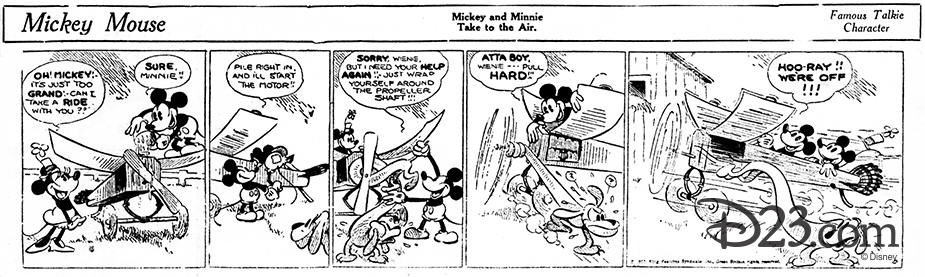
Coming off the success of producing “shorts” for the film industry (I think everyone knows Steamboat Willie), Walt himself took on the task of creating a daily comic strip – talk about a PIA (pain in the @%$) Job! With the help of his drawing assistant Ub Iwerks and his inking assistant Win Smith, Mickey and Minnie came to life – and the strip lasted over 90 years!! Here’s a little history on the series, the people behind the drawings and the themes, many based on the events of the day, that drove the success for so many years. Enjoy, and thanks to disneydiary.com, Wikipedia and YouTube. Enjoy!
Walter Elias Disney was born in 1901 in Chicago to a family of modest means. In 1919, he met Ub Iwerks while working in commercial art studios in Kansas City. Three years later, the two started their own, ultimately unsuccessful, animation studio. Disney regrouped in California, forming the company we know today with his brother, Roy, as business manager and Iwerks as lead cartoonist.
Though it may seem like Mickey Mouse has always been with us, this most well-known of cartoon characters sprang to animated life on November 18, 1928. The high-spirited, mischievous mouse debuted in Steamboat Willie, a short film designed and animated by Ub Iwerks, the chief animator with the then-nascent Walt Disney Company, with direction from Walt Disney. They cast Mickey Mouse as a shipmate on a steamboat captained by a surly cat. Scheduled to be the opening for a feature-length film, Steamboat Willie was given an initial modest run at the Colony Theater in New York. But audiences and critics went wild for the impish, round-bellied mouse and for the premiere of the first cartoon with synchronized sound.
Two weeks later, Steamboat Willie was re-released at the Roxy, also in New York, and the largest theater in the world at the time. It made silent animation obsolete and launched the Disney empire, as Walt proclaimed…”sound is here to stay”.
After releasing Steamboat Willie, the struggling company began to thrive and to introduce other characters—like Donald Duck and Goofy—into popular culture. As the American economy crumbled during the Great Depression, the Walt Disney Company rose, a paradox explained by the delight, even relief, that its cartoons brought to Americans and audiences worldwide, hungry for a respite from harsh daily realities.
A Mickey Mouse comic strip was suggested by Joseph Connolly, the president of King Features Syndicate, in a July 24, 1929 letter to Disney animator Ub Iwerks: “I think your mouse animation is one of the funniest features I have ever seen in the movies. Please consider producing one in comic strip form for newspapers. If you can find time to do one, I shall be very interested in seeing some specimens.”
The comic strip launched on January 13, 1930 was written by Disney himself, with art by Ub Iwerks. The strip begins with young Mickey as an optimistic, imaginative young mouse living on a farm, and dreaming of becoming a great aviator like his hero, Charles Lindbergh. In a sequence based on the 1928 short Plane Crazy, Mickey puts together a homemade plane, and takes a flight with his girlfriend Minnie. She falls out of the plane, and Mickey travels through a storm to land on a deserted island, inhabited by fierce natives who want to cook him alive.
As these first strips were being released, Iwerks left the Disney studio, signing a contract with Disney competitor Pat Powers to leave Disney and start an animation studio under his own name. Win Smith, who had been inking the strips, took over the penciling as well with the February 10th strip. Smith left the studio in April after a fight with Disney, who wanted him to take over writing the strip.
As a “temporary replacement”, Disney asked a young inbetweener at the studio named Floyd Gottfredson to fill in. Gottfredson’s first strip was published on May 5, and he took over the scripting two weeks later. He would continue as the creative force of the strip for more than 45 years. (WOW!).
While the early months of the strip did have a loose plot, the pace and style were still the standard gag-a-day approach to comic strips. With adventure and daily continuity strips like The Gumps and Wash Tubbs becoming increasingly popular, King Features Syndicate asked Disney to make Mickey Mouse a more serious adventure strip.
This led to the first adventure storyline, “Mickey Mouse in Death Valley”, which ran from April 1 to September 20, 1930. The story—begun by Smith, and continued by Gottfredson—involves a crooked lawyer, Sylvester Shyster, and his thuggish associate Peg-Leg Pete, who kidnap Minnie in order to find a map to her Uncle Mortimer’s hidden gold mine in Death Valley. Mickey and Minnie race Shyster and Pete to the desert, to lay claim to the mine.
Over decades Gottfredson used extended main themes inspired from Disney’s animation department to support the storylines, such as “The Great Orphanage Robbery”, The Case of the Vanishing Coats”, “The Robin Hood Adventure”, “Mighty Whale Hunter” and “Lil Davey” based on Davey Crockett.
Years later, many of these themes became book titles, extending the series into children’s bedrooms. I can remember reading some of the storybooks to the girls when they were little (For a full list, CLICK.) and now enjoy reading to the grandkids.
Thanks Walt and team!
::::::::::::::::::::::::::::::::::::::::::::::::::::::::::::::::::::::::::::::::::::::::::
DO YOU LIKE CONTESTS?
Me, too.
As you may know the Kowalski Heat Treating logo finds its way
into the visuals of my Friday posts.
I. Love. My. Logo.
One week there could be three logos.
The next week there could be 15 logos.
And sometimes the logo is very small or just a partial logo showing.
But there are always logos in some of the pictures.
So, I challenge you, my beloved readers, to count them and send me a
quick email with the total number of logos in the Friday post.
On the following Tuesday I’ll pick a winner from the correct answers
and send that lucky person some great KHT swag.
So, start counting and good luck!
Oh, and the logos at the very top header don’t count.
Got it? Good. :-))))
Have fun!!
::::::::::::::::::::::::::::::::::::::::::::::::::::::::::::::::::::::::::::::::::::::::::
 Out of a can or home-made, soups really are mmm-mmm-good!! :))))
Happy New Year to all my blog readers – I hope you had a safe, fun holiday with family and friends. My wish to you in the New Year is that you prosper in health and wealth, grounded in your faith and love of your families. Over the holidays I was able to really enjoy some wonderful soups (and chili). When the mercury dropped below zero, I was the first at the table with spoon in hand to lap up some of Jackie’s creations. As a “foodie” (my definition is “eat everything”), soup and hearty sandwich on a blustery day is at the top of my list. (who doesn’t dip your sandwich in the soup?) And when you are feeling down, there’s NOTHING like a bowl of steamy chicken noodle soup. I know every family has “their” recipe and way of making it – as chicken soup is undeniable the dish that has souped its way into the hearts of people throughout the world and has become a staple ‘rainy day’/’sick day’ comfort meal. Here’s a little history, some recipes to try, and a great production video on how soup is made for my production buds out there. If you have a “to die for” family recipe, please email it to me at skowalski@khtheat.com and I’ll ask Jackie to give it a try. Thanks to Wikipedia, The Oxford Student, You Tube and the recipe folks for the info – ENJOY! (and don’t forget the crackers – saltines or oyster or wheat or Ritz or … perhaps another blog topic 😊.
Chicken soup is a soup made from chicken, simmered in water, usually with various other ingredients. The classic chicken soup consists of a clear chicken broth, often with pieces of chicken or vegetables; common additions are pasta, noodles, dumplings, or grains such as rice and barley. Chicken soup has acquired the reputation of a folk remedy for colds and influenza, and in many countries is considered a comfort food.
Chicken soup has been with us for a long, long time, and there its fame has made its history so easy to find. People have obsessed over chicken soup since the domestication of fowl around 7,000 to 10,000 years ago in Southeast Asia. The Ancient Greeks also had their own version of chicken broth and believed the soup to have healing properties much like today.
Variations on the flavor are gained by adding root vegetables such as parsnip, potato, sweet potato and celery root; herbs such as bay leaves, parsley and dill; other vegetables such as zucchini, whole garlic cloves, lettuce, or tomatoes; and black pepper. Saffron or turmeric are sometimes added as a yellow colorant.
Chicken soup is the undoubtable symbol of Jewish cuisine. But the hot broth — made of scarce and expensive fresh meat — was not always readily available in every Eastern European community. There was one day a year when every family, rich or poor, prepared the soup: Yom Kippur, the Jewish Day of Atonement. “At night, the people of the village [Cycow in Poland] would wave fluttering chickens above their heads for the atonement ceremony called kapparot, and right after the ceremony people marched in droves to the slaughterhouse,” recalled Shmil Holand in his book “Schmaltz.” A few hours later, the village was filled with the aroma of fresh chicken soup, which was then served before the Yom Kippur fast.
While every chef has their own approach, some terms to keep in mind when creating your base:
Some ingredient variations to try from around the world include:
If you are brave enough to veer from tradition, here are a few recipes to try:
>>THIS ONE
>>THIS ONE
>>AND THIS ONE
::::::::::::::::::::::::::::::::::::::::::::::::::::::::::::::::::::::::::::::::::::::::::
DO YOU LIKE CONTESTS?
Me, too.
As you may know the Kowalski Heat Treating logo finds its way
into the visuals of my Friday posts.
I. Love. My. Logo.
One week there could be three logos.
The next week there could be 15 logos.
And sometimes the logo is very small or just a partial logo showing.
But there are always logos in some of the pictures.
So, I challenge you, my beloved readers, to count them and send me a
quick email with the total number of logos in the Friday post.
On the following Tuesday I’ll pick a winner from the correct answers
and send that lucky person some great KHT swag.
So, start counting and good luck!
Oh, and the logos at the very top header don’t count.
Got it? Good. :-))))
Have fun!!
::::::::::::::::::::::::::::::::::::::::::::::::::::::::::::::::::::::::::::::::::::::::::

Each year I love to take time and make plans for my New Year’s resolutions. Like you, I’ve made some really big ones – BEHAGS for short – and some that just are never going to happen (grow hair, get taller, dunk a basketball, sing in the choir (I’m not even allowed to sing in the shower!) – you know, those magical ideas we conger up, only to be disappointed come spring that it just ain’t gonna happen. This year, I’m taking a different track – simplifying my list (yes, I’m a list guy … actually a pile guy (if it’s in the right pile, I can deal with it). My goal is no piles! I want to select some goals that are honest, specific, and reasonable. So, I’ve decided to boil them down into three categories – something for my mind, something for my body, and something for my soul. Now, my challenge is, what are the specifics??
My Mind – for those that know me, I think I’m fairly level-headed. I have a thirst for knowledge, a drive for good outcomes, and truly love understanding situations, and then solving problems. It’s driven from our PIA (pain in the @%$) Jobs! mindset, handed down from Dad and Mom while embraced by my gang here at KHT. I’ll admit, it gets me revved up every time we can solve problems for our customers. For me though, it tends to creep into my everyday life. One of my favorite sayings is “That’s Easy”) That “little voice” inside my head that says, come on Steve, you can figure this out.” Whether it’s underneath the sink fixing a leak, working with my daughters on various projects, trying to assemble a toy for the grandkids, or hitting a chip from 74 yards off hardpan to an elevated green…it’s the same. Be patient, think it through, trust your instincts, don’t overreact… and then the outcomes – sometimes good, sometimes not so good. My goal for ’23 is to do a better job of learning from my mistakes, staying more patient, and to just keep trying until I get it right. Before jumping in, I’ll check to see what the experienced experts say, and then give it a go. I’ll be a bit more “mindful”.
My Body – on the surface, this one’s easy – eat better, exercise more, limit overindulgences, take my vitamins, get good night’s sleep, listen to the doctors… yea, yea yea. I’ve decided NOT to get caught up in the latest fad or put out some silly weight goal – (for those who’ve seen me eat, you know this is silly). Instead, I’ve decided to combine my workouts with my first goal – I’ll keep running (and enjoy it) and mix in a few more events with my girls (we LOVE 5 & 10 K’s – plus I’m a sucker for those event tee shirts). I’m going to set aside more time to go on walks with Jackie – in the woods and on the beach. And, I’m going to take care of my skin – sunblock and cover ups. For those who know me, sunblock on my head is an absolute must! Now that I’m advancing into my older years (I like to say finally growing up….. a little! it’s silly to over push with weights and exercise – instead, I’m combining it with friends and family – carry my grandkids more, walk the courses rather than riding with my kids or buds, and get out of work a bit earlier to enjoy the great weather we have here in NE Ohio with my incredible wife.
My Soul/Spirit – I’m blessed with an amazing upbringing – Mom and Dad knew how important my spiritual well-being is, and set the foundation for my spiritual upbringing – I enjoyed Catholic schools, attend mass and continue to stay routed in my faith. But, honestly, I can do more, with all of the blessings I’ve received and continue to receive I tend to “forget” how important God is in my life. I’m committing to spending more time with my Lord and Savior – reading, learning from the bible and living a more spiritual life. Quite honestly, the harder I work on this one, I think the better I’ll do on my first two!! I also plan to pass along my faith to my grandkids – be a role model “father- grandfather in action and in words”. It’s easy to talk, much more difficult to make it happen – but I’m up for it.
So – there you have it – hopefully it spurs you on to set your own goals for ’23. Skip the silly lists, and make some of your own.
Good luck – and God Bless.