
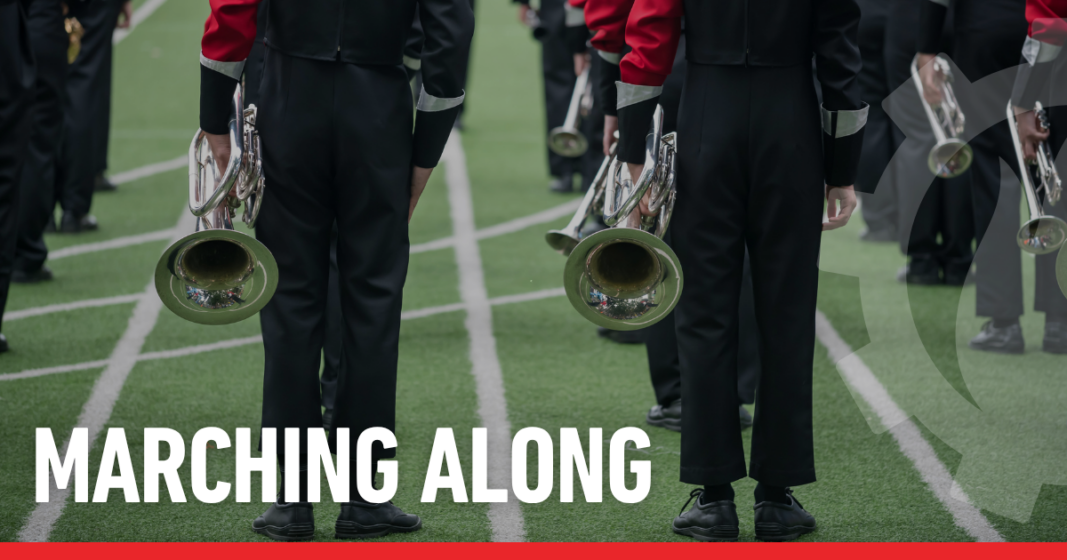
Marching Along
I’m really blessed to live in a wonderful community west of downtown Cleveland. One of my favorite things to do in the Fall is attend a few of my town’s high school football games. Even though my girls are grown, Jackie and I still enjoy watching the kids play and especially the halftime show, featuring the marching band, especially with the grandkids coming along, it’s an entirely different perspective watching the action through their eyes! Over the past few nights, I can hear them practicing – especially the drum line, and then the full band echoing from the stadium. It got me to thinking about the history of marching bands – when they were first created, and how they’ve evolved over the centuries to the entertaining approaches they use today (I love it when the kids dance while playing). Watching the band and girls’ precision drill team work together is amazing – the talent! So, here’s some history and trivia I found online. Also, a video of my favorite “best damn band in the land”. Special thanks to Google and Wikipedia for the info. Enjoy!

A marching band is a group of instrumental musicians who play while marching.
Instruments have been frequently used on the battlefield (for example, the Iron Age carnyx). The modern marching band developed from European military bands formed in the Baroque period, partly influenced by the Ottoman tradition. 17th-century traveler Evliya Çelebi noted the existence of 40 guilds of musicians in Istanbul. In the 18th century, each regiment in the British Army maintained its own military band. Until 1749, bandsmen were civilians hired at the expense of the colonel commanding a regiment. Subsequently, they became regular enlisted men who accompanied the unit on active service to provide morale-enhancing music on the battlefield and often to act as stretcher bearers.
Instruments during the 18th century included fifes, drums, the oboe (hautbois), French horn, clarinet, and bassoon. Drummers summoned men from their farms and ranches to muster for duty. In the chaotic environment of the battlefield, musical instruments were the only means of commanding the men to advance, stand or retire. In the mid-19th century, each smaller unit had its own fifer and drummer, who sounded the daily routine. When units massed for battle, a band of musicians was formed for the whole.
Before radios, music and drum patterns were a practical way to transmit commands, signal when to start moving, change pace, form ranks, rally, or advance, and fifes or bugles could carry distinct signals farther than shouting.
From the Ottoman Empire, the idea spread into northern Europe and then to the Americas. In Revolutionary-era America, fife and drum corps became common, and by the Civil War, bugles had joined as important signaling instruments.
Modern marching bands are a civilian offshoot of that military tradition. Military-style uniforms, ranks, and formation marching all come from those older armed-forces models. A later American example of the entertainment side was the first recorded football-game marching music in 1907 at the University of Illinois.
Military bands became especially important during the American Civil War. Nearly every regiment had musicians. After the war, veterans brought their love of military music home. Communities formed town bands, often playing in gazebos, parades, and civic celebrations. These “community bands” became fixtures of small-town America.
The connection between marching bands and football began in the late 1800s as colleges looked for ways to entertain crowds during breaks in games. One of the earliest and most influential examples was the University of Notre Dame Band, founded in 1845, and the Purdue All-American Marching Band, which helped popularize halftime performances.
By the early 1900s, bands were no longer simply marching in straight lines. Directors began experimenting with formations, letters, symbols, and coordinated drills. And high schools soon followed suit.
Fun Fact – the giant wrap-around sousaphone that could project over the whole band was named after John Philip Sousa, often called “The March King.”
Cheerleading developed separately from bands. The first organized college cheer is generally credited to Johnny Campbell in 1898 at the University of Minnesota, when early cheerleaders were almost entirely male. By the 1920s and 1930s, women increasingly joined cheer squads, and by the postwar era cheerleading became a standard feature of football games. Bands and cheerleaders evolved together because both served the same purpose: energizing the crowd and building school spirit.
The colorful flag performers seen today have military origins as well. Historically, soldiers carried flags, banners, and standards into battle. These visual markers identified units and served as rallying points. During the 1950s and 1960s, marching bands began incorporating “flag corps” to add visual excitement to performances, along with rifles, sabers, and dance.
With the growth of suburban schools, expanding music education programs and Friday-night “football culture”, in many small towns, the marching band became one of the most visible symbols of local pride.
Band Trivia
- The largest marching bands can exceed 500 performers.
- A typical sousaphone weighs between 25 and 35 pounds.
- Competitive bands may march several miles during a single performance and practice day.
- Many drill formations are now designed using sophisticated computer software.
- The halftime show, now expected at football games, was once considered a novelty.
- The Ohio State University Marching Band fields about 228 musicians and is considered the largest all-brass-and-percussion marching band in the world.
- The Florida State University Marching Chiefs regularly exceeds 400 members.
- The Bowling Green State University Falcon Marching Band reached 425 members and is among the largest collegiate bands in America.
While our ancestors marched across battlefields carrying fifes and drums, today’s students march across football fields carrying on a different mission: creating school spirit, community pride, and memories that last a lifetime. In my town, the band is more than entertainment – it’s one of the organizations that brings together students, parents, alumni, and residents of every generation behind a common cause. Spirit!
How did you do on our last logo contest?
Check out our logo guide for the “Just Give Me a Second” post here!




Leave a Reply
Want to join the discussion?Feel free to contribute!