
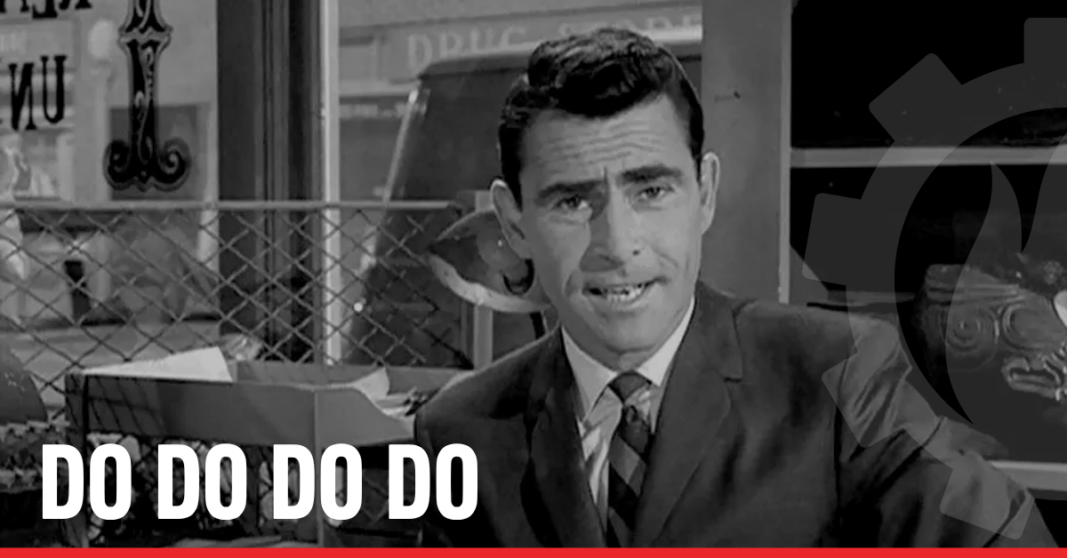
“Do Do Do Do – Do Do Do Do”
For those of us old enough to remember, and those of us who enjoyed late-night Friday sleepovers watching reruns with our BFFs, there is simply nothing more incredible, thought-provoking, and memorable than Rod Serling and his classic hit TV Series, The Twilight Zone. The show debuted on this day way back in 1959, ran for five seasons, and has become renowned for its great art, mind-bending science fiction themes, and television quick production brilliance. I’m guessing you know exactly what is coming when you hear this intro theme music, created for the second season, and these words, etched into our minds… “You’re traveling through another dimension, a dimension not only of sight and sound but of mind; a journey into a wondrous land whose boundaries are that of imagination. Next stop … the Twilight Zone!”
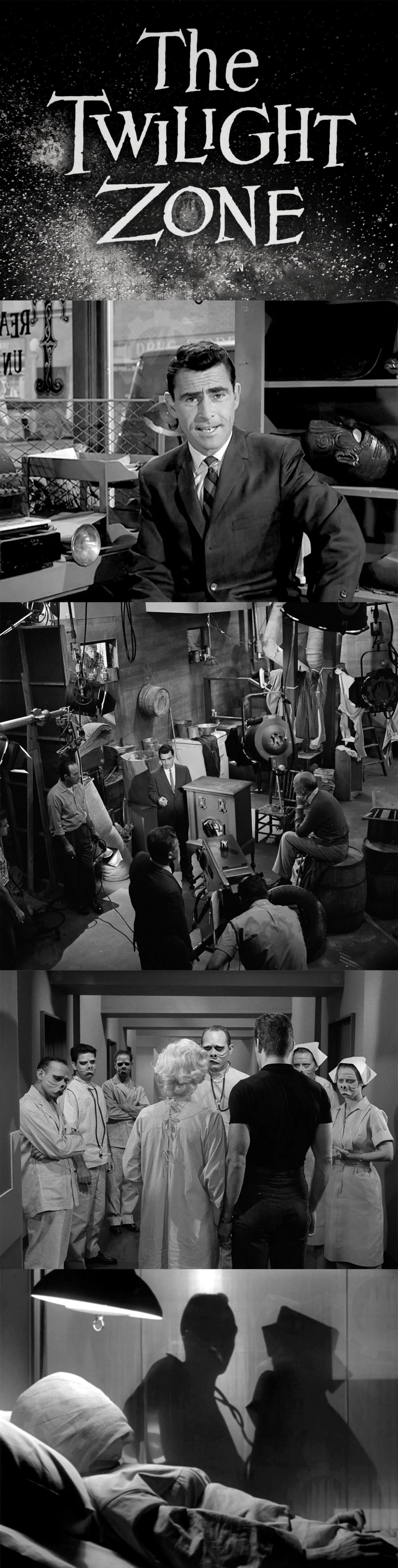
(just writing this brings back great memories!) Most of us use the phrase “Twilight Zone” when we’re in that unknown, disoriented space – not quite sure what’s real and what’s imaginary. And, for Rod Serling, it was the place of his genius, as he combated censors in Hollywood, confounded advertisers, and challenged our understanding of politics, motivations, reason, and fears. Along the way, he shied away from popular actors and instead showcased amazing young talent, letting them show their acting abilities. I went online and found a ton of info and did my best to provide just enough for your reading. Be sure to send me your memories (skowalski@khtheat.com) about the show and episodes that stick with you, and I’ll share with you my own, such as William Shatner’s “monster on the plane wing.” Enjoy! (and good luck going to sleep tonight!!!)
The Twilight Zone (marketed as Twilight Zone for its final two seasons) is a fantasy science fiction horror anthology television series created and presented by Rod Serling, which ran for five seasons on CBS from October 2, 1959, to June 19, 1964. Each episode presents a standalone story in which characters find themselves dealing with often disturbing or unusual events, an experience described as entering “the Twilight Zone”, often with a surprise ending and a moral. The phrase “twilight zone” has entered the vernacular, used to describe surreal experiences.
The series featured both established stars and younger actors who became much better known later, such famous names Bill Bixby, Charles Bronson, Carol Burnett, Donna Douglas, Robert Duvall, Buddy Ebsen, Peter Falk, Joan Hackett, Dennis Hopper, Ron Howard, Jim Hutton, Jack Klugman, Martin Landau, Cloris Leachman, Jean Marsh, Elizabeth Montgomery, Julie Newmar, Leonard Nimoy, Robert Redford, Burt Reynolds, Telly Savalas, William Shatner, George Takei, Joyce Van Patten, Jack Warden, Jonathan Winters, Dick York, Burgess Meredith, and Mickey Rooney. (WOW!)
Rod Serling served as executive producer and head writer, writing or co-writing 92 of the show’s 156 episodes. He was also the show’s host and narrator, delivering monologues at the beginning and end of each episode, and typically appeared on-screen to address the audience directly during the opening scene. Serling’s opening and closing narrations usually summarize the episode’s events, encapsulating how and why the main characters had entered the Twilight Zone.
Serling thought that a science fiction setting would give him more freedom and less interference in expressing controversial ideas than more realistic settings. “The Time Element” was Serling’s 1957 pilot pitch for his show, a time travel adventure about a man who goes back to Honolulu in 1941 and unsuccessfully tries to warn everyone about the impending attack on Pearl Harbor. The script was rejected and shelved until Bert Granet discovered and produced it as an episode of Desilu Playhouse in 1958. The show was a great success and enabled Serling to begin production on The Twilight Zone.
While the show proved popular with television critics, it struggled to find a receptive audience. Still, the show attracted a large enough audience to survive a brief hiatus in November, after which it finally surpassed its competition on ABC and NBC and persuaded its sponsors (General Foods and Kimberly-Clark) to stay on until the end of the season.
Both sponsors appeared ready to pull out. Even if the show continued, CBS was said to be planning to replace Serling with a more prestigious host and narrator, even offering it to Orson Welles, but found him to be too expensive. In the end, everything was worked out. Only Kimberly-Clark dropped their sponsorship, and Colgate-Palmolive stepped in as the replacement sponsor. Orson Welles turned down the offer to do the show. While this was taking place, Serling went to New York, hoping to at least preserve the right to do the closing narration. To his surprise, the network did a complete reversal. Instead of dropping him, it expanded his role as host by having him also do an opening introduction.
With the exception of “The Chaser“, the first season featured scripts written by Rod Serling, Charles Beaumont and Richard Matheson. The trio was responsible for 127 of the 156 episodes in the series. With the exception of “A World of His Own“, Serling never appeared on camera during any first-season episode, as he would in future seasons, presenting only as a voice-over narrator.
Many of the season’s episodes proved to be among the series’ most celebrated, including “Time Enough at Last“, “The Monsters Are Due on Maple Street“, “Walking Distance“, and “The After Hours“. The first season won Serling an unprecedented fourth Emmy Award for dramatic writing, a Producers Guild Award for Serling’s creative partner Buck Houghton, a Directors Guild Award for John Brahm, and the Hugo Award for best dramatic presentation.
Serling pushed the crew and actors for every episode, delivering scripts just the day before shooting, which ran 12-14 hour days. A chain smoker, he often overpowered the set with his cigarette smoke, requiring the crew to install fans to clear the air so the cameras could roll without interference.
Serling said he wasn’t trying to make a science fiction show. He wanted to write dramas that tackled racism, war, prejudice, censorship, greed, paranoia, and political corruption. But television sponsors in the 1950s often pressured writers to avoid controversial subjects. Serling discovered something clever, as many of his stories explore guilt, loss, fear, and the consequences of violence. His wartime experiences as a paratrooper gave emotional weight to stories that otherwise might have seemed like simple fantasy. The Cold War, nuclear weapons, McCarthyism, conformity, and the Space Race all influenced the stories. Even when aliens were involved, viewers recognized the real-world anxieties hiding beneath the surface.
Many episodes look surprisingly polished today, but the show’s budget was very modest. Instead of relying on expensive special effects, the writers leaned on great storytelling, clever camera work (especially in black and white, as it hid many of the simple props), strong acting, and, of course, memorable twists. Sometimes what you didn’t see was scarier than what you did, as our imagination often supplied what the budget couldn’t.
The Twilight Zone taught audiences to expect the unexpected, as episodes frequently ended with shocking reversals that forced viewers to rethink everything they’d just watched. The series proved that everyday objects like a window, a camera, a stopwatch, a doll, or even a pair of glasses could become terrifying in the right story.
One phrase many people associate with the show, “Submitted for your approval…”, was never a standard catchphrase. Serling used it only occasionally, yet it became so memorable that countless people believe he said it in every episode. Funny how our memory works.
Some episodes ended with hope rather than horror, while some were funny, sentimental, or bittersweet. That’s the reason the series has aged so well, as it explored nearly every human emotion.
Most television shows entertain us for an hour. The Twilight Zone entertained us…then quietly asked us to examine within ourselves long after the show was over. Its stories weren’t really about monsters hiding in the shadows, or people seeing aliens. They were about the thoughts and fears that hide inside regular people. And perhaps that’s why, more than six decades later, audiences are still willing to “step into…” (go ahead and say it out loud)
See if you remember any of these classic episodes – (don’t turn out the lights!!)
How did you do on our last logo contest?
Check out our logo guide for the “Now That’s Debatable” post here!




Leave a Reply
Want to join the discussion?Feel free to contribute!