
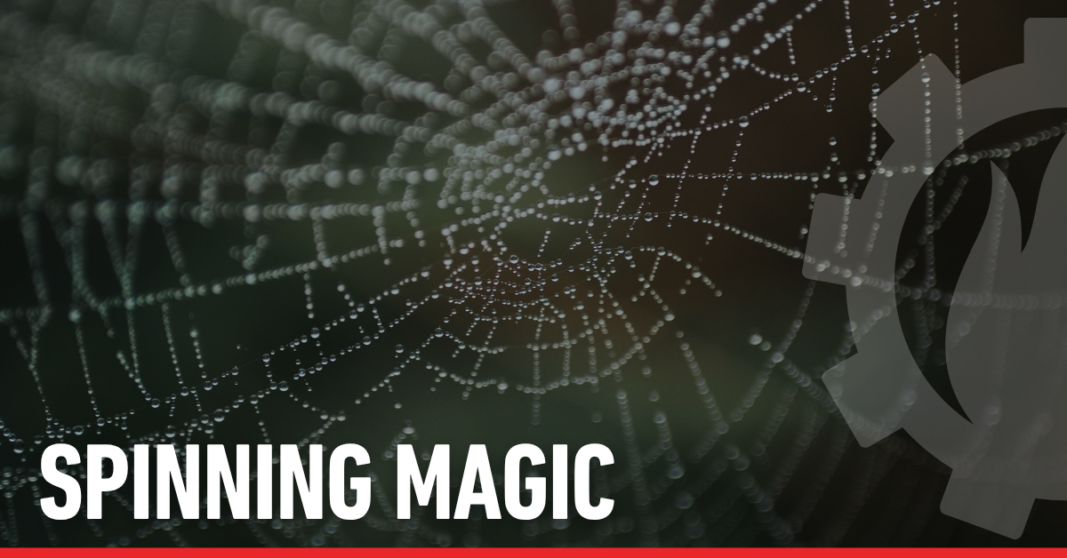
Spinning Magic
The other day I was heading into the office, turned the corner, and got a face full of spiderweb – followed by the embarrassing “A !@#$%^&*%$#@$$#^&, spiderweb on me” dance, while frantically wiping it from my body. I hope no one saw me! My girls know how I really feel about spiders! That delicate strand sticking to my face is annoying, but of course it got me thinking about just how cool those webs are, especially after just watching the latest Spider-Man movie! Watching a spider weave a web is something (talk about PIA (pain in the @%$) Jobs)! Slow, methodical, and with a special purpose, each spider uses their webs for different reasons. A bit of time on the computer helped reinforce my knowledge of just how incredibly strong, remarkably elastic, and extraordinarily lightweight the silk webs are. Spiders can turn it into everything from a sophisticated insect trap to an egg case, a shelter, a safety line, and even a kind of aerial transportation system. Here’s some fun info I found, along with a little “Peter Parker” insight that hopefully sticks with you (get it?) Enjoy!

A spider web, spiderweb, spider’s web, cobweb, or even just web (from the Middle English coppeweb) is a structure created by a spider out of proteinaceous spider silk extruded from its spinnerets, generally meant to catch its prey. Spider webs have existed for at least 100 million years. The term “spider web” is typically used to refer to a web that is apparently still in use (i.e., clean), whereas “cobweb” refers to a seemingly abandoned (i.e., dusty) web.
Almost all spiders produce silk, and they don’t necessarily make webs. There are roughly 50,000 known spider species, and many don’t build the familiar geometric webs we see stretched between trees and porch railings. Some actively hunt their prey, while others use silk for egg sacs, shelters, safety lines, or other purposes. The silk begins as a liquid protein inside the spider’s abdomen. It is forced through tiny structures called spinnerets, where the material is transformed into solid silk fibers. Most spiders have three pairs of spinnerets, each having its own function. Each gland produces a thread for a special purpose, such as a trailing safety line, sticky silk for trapping prey, or fine silk for wrapping it. Spiders use different gland types to produce different silks, and some spiders are capable of producing up to eight different silks during their lifetime.
Spider silk has become something of a celebrity in materials science because of its extraordinary combination of strength, toughness, and elasticity. The famous comparison is that certain spider silks, measured pound-for-pound, can be several times stronger than steel. Spider silk is also extremely lightweight. When scientists compare materials by weight, spider silk performs spectacularly.
The secret behind a spider web’s stickiness lies in the tiny glue droplets dotting its silk threads. Orb-weaver spiders, such as Larinioides cornutus, coat their silk with a special hygroscopic substance that keeps the glue soft and tacky by drawing in water from the air. This built-in humidity control prevents the adhesive from drying out too quickly. The hardening of the viscoelastic protein is indirectly controlled by changes in water content, which in turn affect the concentration of the ionic liquid. As this balance shifts, the glue’s viscosity adjusts, helping the web maintain its grip on captured prey.
When most people hear “spiderweb,” they picture the classic circular orb web. But spiders are architectural specialists. Different species build dramatically different structures. Cool web-building videos:
Orb webs: These are the familiar, almost perfect geometric webs associated with orb-weaver spiders. They feature radial lines extending from the center, crossed by spiral threads. They’re beautiful and functional.
Sheet webs: Some spiders construct broad, horizontal sheets of silk across vegetation or other surfaces. The spider may hide beneath the sheet while waiting for prey. You can see these on the grass on dewy mornings.
Funnel webs: Funnel-weaving spiders create a sheet that leads toward a tunnel or funnel. When prey wanders onto the web, the spider races out from its hiding place.
Tangle webs (or cobwebs): These are the seemingly chaotic webs we often find in corners, sheds, and basements. They’re associated with spiders such as the black widow family. (yikes).
Spiderwebs don’t last forever. Wind, rain, dust, insects, and other animals can damage them. For many web-building spiders, rebuilding is simply part of the job. Some orb-weaving spiders may take down and rebuild their webs regularly. In fact, some spiders consume portions of their old web, recycling the proteins and materials rather than simply throwing everything away. Some spiders even use silk as a sort of parachute.
Spider silk sounds like the perfect industrial material. It’s strong, lightweight, flexible, and biodegradable. So why don’t we simply raise millions of spiders and harvest their silk? Humans have tried. Designers Simon Peers and Nicholas Godley assembled silk from more than a million golden orb-weaver spiders in Madagascar to create an enormous textile. The resulting work was displayed at London’s Victoria and Albert Museum. (The scale is almost unbelievable, as more than one million spiders contributed to the project). Researchers remain interested in potential applications ranging from advanced textiles to medical materials and other high-performance fibers.
For centuries, people have used spiderwebs in folk medicine and wound care. Ancient writers described placing spiderwebs over wounds, and the practice continued in various forms through European history. The historical use of spiderwebs probably reflected their physical ability to form a covering and help with bleeding rather than some magical medicinal property.
The web itself can transmit vibrations. When an insect struggles in the silk, the vibrations travel through the structure. (In effect, the web becomes part of the spider’s sensory system, like having a giant alarm system stretched across your living room.
And, our favorite superhero of the summer. Spider-Man first appeared in Amazing Fantasy #15, published in 1962, created by writer Stan Lee and artist Steve Ditko. The story introduced teenager Peter Parker, who gains spider-like abilities after being bitten by a radioactive spider.
In the original comic-book concept, Peter Parker’s webbing was famously produced by mechanical web-shooters that he designed himself, an important part of the character. He’s also a brilliant young scientist and inventor.
Spider-Man wasn’t originally designed to be everyone’s favorite hero (that was part of the point). Peter Parker was a teenager. He had problems. He worried about money. He had challenges at school. He was awkward, just a kid trying to figure things out.
Spider-Man’s webbing has been used for just about everything – swinging between buildings (my favorite!), catching criminals, creating temporary barriers, stopping vehicles, creating web nets, and, occasionally, doing things that would make a materials scientist raise both eyebrows.
And of course his spider sense. Real spiders don’t have Spider-Man’s sixth sense; they do have an extraordinary ability to detect vibrations, movement, and changes in their environment through their webs and bodies. Marvel essentially took a real characteristic of spiders’ extraordinary sensitivity to their surroundings and turned it into a superhero superpower – genius!
More than six decades later, Spider-Man remains one of the world’s most recognizable superheroes—and this summer, Spider-Man: Brand New Day has once again demonstrated just how powerful that character remains at the box office.
How did you do on our last logo contest?
Check out our logo guide for the “BLT Please” post here!




Leave a Reply
Want to join the discussion?Feel free to contribute!