
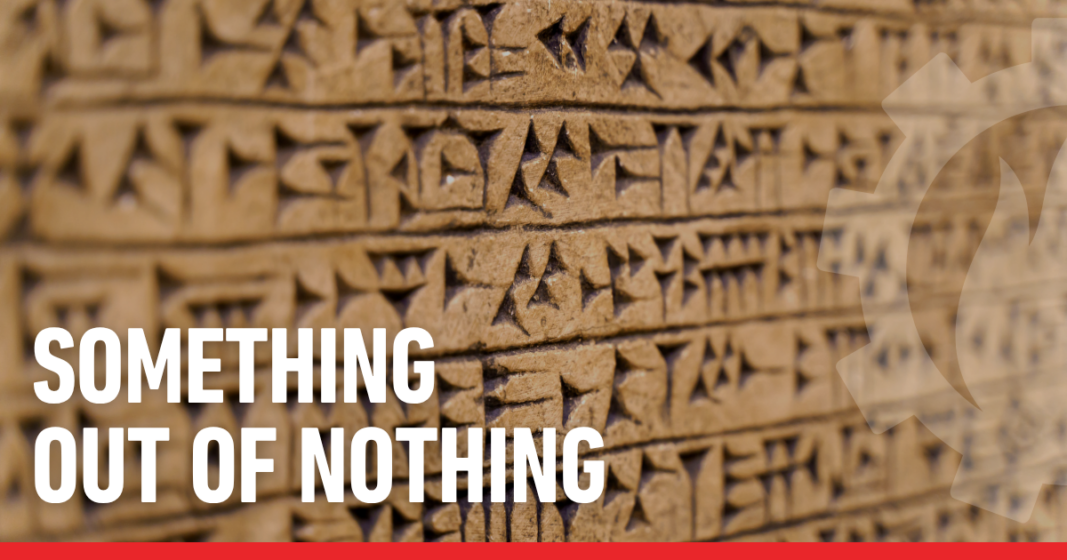
Something out of Nothing
The other day, I was out on the shop floor ”visiting” with my team (actually simply being nosy!) when I came across an empty box – a container of “nothing.” Once again, my amazing team had completed another wonderful PIA (pain in the @%$) Job for a very good customer – something that always puts a big smile on my face. After finishing my walk-about, I headed back to the office to get back to the next task at hand and continue looking out at beautiful Lake Erie. Remembering the empty box on the shop floor, it got me to thinking about “nothing” – and common nicknames we have for nothing – zero, zilch, nada, zippo, goose egg, squat, bupkis, nix, nil, and love (tennis), and of course, the old Seinfeld episodes came to mind as well (the show about nothing). Jackie and my girls often tell me that my mind works in mysterious ways (when they’re being kind!) Of course, I had to jump on the internet and start digging, trying to learn a bit more about nothing, asking myself, “Is there something behind nothing?” WOW! What a history, reaching way back in time to cultures and peoples of ancient times from across the world. Here’s some history and trivia I think you’ll enjoy, about nothing (that was fun to write!). Enjoy the journey (and yes, there is a song you may remember about zero) and a great Seinfeld clip. Enjoy!

0 (zero) is a number representing an empty quantity. Adding (or subtracting) 0 to any number leaves that number unchanged; in mathematical terminology, 0 is the additive identity of the integers, rational numbers, real numbers, and complex numbers, as well as other algebraic structures. Multiplying any number by 0 results in 0, and consequently, dividing by 0 is generally considered to be undefined in arithmetic
For most of human history, numbers existed without a concept of “nothing.” Ancient civilizations like the Egyptians and Romans could count and calculate, but had no symbol for zero. This made large or complex calculations awkward, especially when trying to distinguish values like 1, 10, and 100. The idea that “nothing” could be something worth writing down simply hadn’t taken hold yet.
Around 4,000–5,000 years ago, Sumerians and later Babylonians began leaving blank spaces in their number systems to show an empty place value. Eventually, the Babylonians used a small wedge symbol (around 300 B.C.) to mark this absence. However, this wasn’t a true zero; it was just a placeholder, not a number you could calculate with. Still, it was a critical first step toward modern mathematics.
In Han Dynasty China, mathematicians also employed a decimal positional system, particularly evident in the classic text Nine Chapters on the Mathematical Art. Using counting rods, they represented numbers and performed complex calculations, including solving systems of linear equations. In these rod calculations, the absence of a unit in a specific place value was indicated simply by leaving a space (an “empty position”). Like the Babylonians, this was a functional placeholder concept crucial for their positional system, but there was no explicit written symbol for zero.
The Maya civilization developed their own version of zero around A.D. 350. They used a shell-shaped symbol in their calendar system to represent an empty position. Unlike earlier systems, this was a clear and intentional symbol for “nothing,” used consistently in calculations. It stands as one of the rare examples of a mathematical idea invented independently across the world from a common origin.
The archaic Greeks had no symbol for zero (μηδέν, pronounced mēdén), and did not use a digit placeholder for it. According to mathematician Charles Seife, after the Babylonian placeholder zero shows up sometime shortly after 500 BC, Greek astronomers began to use the lowercase Greek letter ό (όμικρον: omicron) as a placeholder or representation of ground-level/null degree value. However, after using the Babylonian placeholder zero for astronomical calculations, they would typically convert the numbers back into Greek numerals.
The true turning point came in India around the 5th–7th centuries A.D. when mathematicians began treating zero not just as a placeholder, but as a number with its own meaning. In 628 A.D., Brahmagupta formalized rules for zero, including that a number minus itself equals zero. This moment transformed zero from a symbol of absence into a powerful mathematical tool. In essence, he made something out of nothing – brilliant! (wonder if he wrote early computer code too??)
In India, zero was deeply tied to the philosophical idea of “śūnya,” meaning emptiness or void. This connection helped thinkers accept that “nothing” could still have structure and rules. Unlike in Greece or Rome, where the concept felt paradoxical or even unsettling, Indian scholars embraced it. This cultural openness helped zero evolve into a usable number.
From India, the concept of zero traveled along the silk trade routes into the Islamic world. Persian mathematicians like al-Khwarizmi incorporated zero into algebra, helping standardize its use. The Arabic word “sifr” (meaning empty) eventually gave us the word “cipher.” This period turned zero into a cornerstone of global mathematics.
Zero arrived in Europe around the 1100s, largely through the work of Fibonacci, who learned of it in North Africa. Many Europeans distrusted the idea of nothing as a number, and some even associated it with fraud or mysticism. For centuries, Roman numerals persisted without zero. It wasn’t until the 1600s that zero became standard in European mathematics.
Once accepted, zero became essential to the scientific revolution. Mathematicians like Newton and Leibniz used it to develop calculus, which depends on understanding values approaching zero. Concepts like velocity, acceleration, and limits all rely on zero in fundamental ways. Without zero, modern physics and engineering would be impossible.
In today’s world, zero is everywhere, especially in computing. Binary code, the language of computers, is built entirely on 0s and 1s. Every email, image, and video ultimately reduces to patterns of zeros and ones. For example: 01001000 01100101 01101100 01101100 01101111 00100001 means “hello”.
Artificial intelligence runs on massive streams of binary data, where zero plays a constant role in logic, storage, and computation. Neural networks process information through mathematical models that depend on zero as a baseline and reference point. Even the idea of “zero error” or optimization toward zero drives machine learning. In a sense, modern AI is built on mastering “nothing” at scale.
What began as a symbol for “nothing” … now powers everything. Greek philosopher Parmenides said you can’t make something out of nothing (or was that Machine Gun Kelly?) … they may want to rethink that thought.
How did you do on our last logo contest?
Check out our logo guide for the “Dreamy Satisfaction” post here!




Leave a Reply
Want to join the discussion?Feel free to contribute!