

Who Said That?
I just love our language and also finding out the history of things we often think and then say, without really pondering why we say it. A few weeks ago, I had the opportunity to take KHT on the road at the Shot Show in Vegas (thanks to those who stopped by the booth!!). Vegas is just so nutty – it’s a 24/7 playground machine. Like most visitors, I’m fascinated by the sights and sounds of the casinos. I’m not a gambler myself, but I do like watching people play the games, especially roulette (so many different ways to lose your hard-earned money!!). While watching some aggressive gamblers, I felt compelled to say to them, “Hey, don’t put all your eggs in one basket”. Of course, I didn’t (and of course, most of them lost their bets), but afterwards it got me thinking about some of the more common idioms we use in different situations. I did some digging on some of my favorites and found their origins come from literature. Here’s some fun info I dug up (you might say I was “going down a rabbit hole”, “going a bit overboard”, and at times “chasing my tail” – HA! ). Enjoy!
An idiom is a figure of speech that means something different than a literal translation of the words would lead one to believe. For example, “it’s raining cats and dogs” is a common idiom, but it’s not meant to be taken literally: Household pets are not falling from the sky! It’s a colorful way of saying that it’s raining really hard outside.
Idioms occur frequently in all languages. In English alone, there are an estimated twenty-five thousand idiomatic expressions. Because idioms are such interesting ways to get a point across, they’re often seen in literature. In fact, great literature has always been filled with idioms to describe characters and settings in vivid, memorable terms. Whether the authors were the first to coin a phrase or were simply making the best use of the language they heard around them, idioms add sparkle and wit to the works in which they are employed.
“Don’t put all your eggs in one basket.”
Meaning: A warning against risking all one has on the success or failure of one thing.
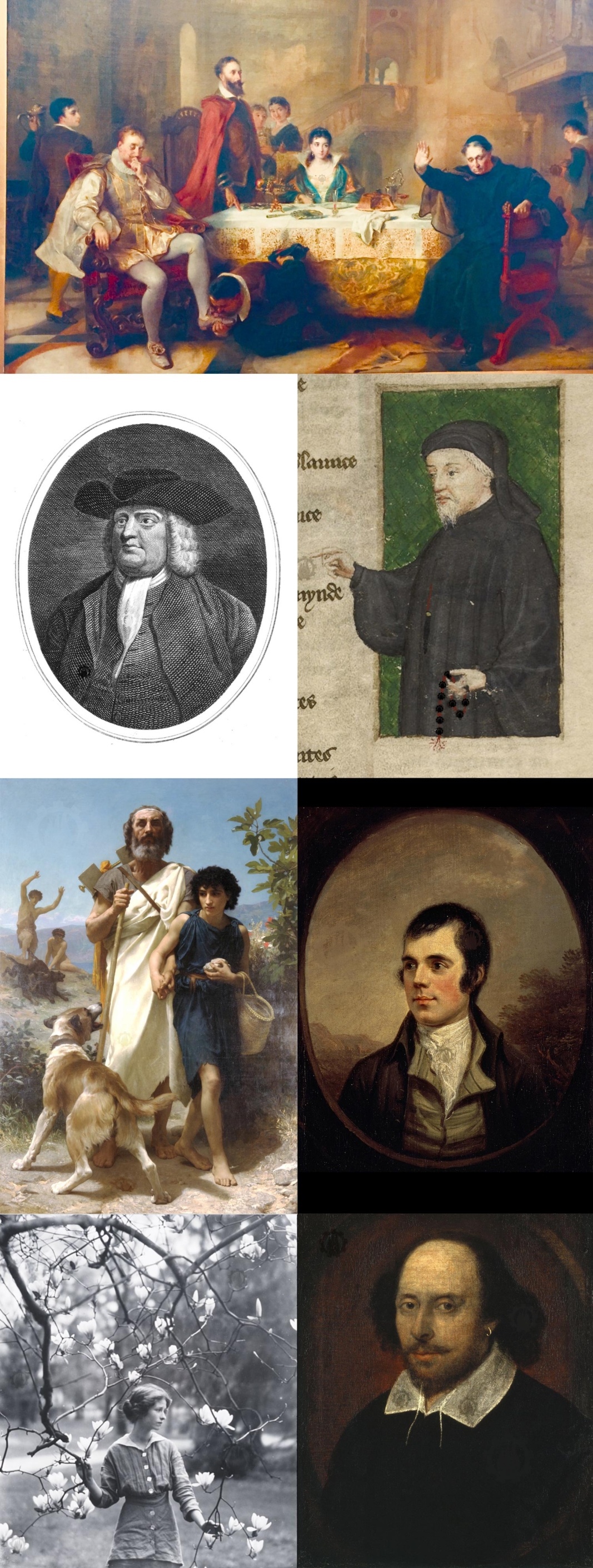
Literary origin: The Ingenious Gentleman Don Quixote of La Mancha by Miguel de Cervantes (1605)
Published originally in two parts in 1605 and 1615, Don Quixote is a fundamental text in the literary canon. The Spanish novel follows the story of a low-ranking noble, Don Quixote, who goes on a journey to become a knight and brings along a farm worker named Sancho as his squire. Sancho, the grounding force in the novel, says, “’Tis the part of a wise man to keep himself today for tomorrow, and not venture all his eggs in one basket.” The squire provides needed common sense in the face of Quixote’s high-minded chivalry mission.
“Pot calling the kettle black.”
Meaning: Essentially, calling someone a hypocrite for criticizing someone else for a fault they also have.
Literary origin: Some Fruits of Solitude by William Penn (1693)
In Thomas Shelton’s English translation of Don Quixote, released in 1620, this phrase appears in a different form: “You are like what is said that the frying-pan said to the kettle, ‘Avant, black-browes.’” William Penn updated the phrase in a 1693 work with an outline of the hypocritical acts that define the idiom: “For a Covetous Man to inveigh against Prodigality, an Atheist against Idolatry, a Tyrant against Rebellion, or a Lyer against Forgery, and a Drunkard against Intemperance, is for the Pot to call the Kettle black.”
“Love is blind.”
Meaning: When someone has fallen in love, they may not see the faults of the people they love.
Literary origin: “The Merchant’s Tale” in The Canterbury Tales by Geoffrey Chaucer (late 14th century)
“The Merchant’s Tale” is a story of falling in love, both virtuously and sinfully. In Middle English, Chaucer wrote, “For loue is blynd alday and may nat see.” The phrasing also appears in Shakespeare’s Two Gentlemen of Verona, Henry V, and The Merchant of Venice.
“Bite the dust.”
Meaning: To fall dead, especially in battle; to suffer humiliation or defeat.
Literary origin: The Iliad by Homer (Eighth century BCE)
Long before Freddie Mercury sang, “Another one bites the dust,” with Queen, the phrase had been in common literary usage since ancient times. Homer’s epic poem The Iliad is all about a war, so the meaning of falling dead or suffering defeat is appropriate. In the translation by Samuel Butler, published in 1898, he wrote in Book II of The Iliad: “Grant that my sword may pierce the shirt of Hector about his heart, and that full many of his comrades may bite the dust as they fall dying round him.” At this point in the story, the armies are marshaling troops and preparing for battle.
“The best laid plans of mice and men”
Meaning: Well-thought-out plans often go awry.
Literary origin: “To a Mouse” by Robert Burns (1785)
The title of John Steinbeck’s 1937 novel Of Mice and Men came from a well-known idiom. Literary people would have known what they were getting with the book because the Scottish poet Robert Burns used a version of the phrase back in 1785. In his poem “To a Mouse,” he declared: “The best laid schemes o’ Mice an’ Men / Gang aft agley.” In this context, he meant plans often go awry.
“Burn the candle at both ends.”
Meaning: To use one’s resources or energies to excess.
Literary origin: “First Fig” in A Few Figs From Thistles by Edna St. Vincent Millay (1918)
Edna St. Vincent Millay coined this extremely useful phrase in a short poem:
“My candle burns at both ends;
It will not last the night;
But ah, my foes, and oh, my friends
It gives a lovely light!”
In the poem, the candle burning from both ends represents a life lived passionately — worthwhile (for its lovely light) even if it shortens the life itself. St. Vincent Millay’s poems and plays were always evocative and pointed. She was the first woman to win the Pulitzer Prize for poetry in 1923.
My list needs to, of course, include William Shakespeare – a master of using the English language in new ways, and many of the figures of speech we use today come from his plays. Here’s a sampling of them:
- Break the ice – This phrase was first used in The Taming of the Shrew. Tranio encourages Petruchio to “break the ice” with Katherine to get to know her, suggesting that he may like her better — and get her to like him. Today, this phrase is used to refer to relieving tension or getting to know someone better, usually by making small talk or a kind gesture to start a new relationship.
- There’s method in my madness – In Hamlet, Polonius observes Hamlet’s antics and says, “Though this be madness, yet there is method in’t.” He suspects Hamlet isn’t behaving as irrationally as he seems to be on the surface. The phrase has changed slightly, but the meaning is the same: Even though your action seems random, you have a purpose to it.
- Dead as a doornail – Though this phrase is perhaps better known as the opening description of Ebenezer Scrooge’s partner Jacob Marley in A Christmas Carol, it was previously used by Shakespeare. In Henry IV, Part 2, Jack Cade says, “I have eaten no meat these five days; yet, come thou and thy five men, and if I do not leave you all as dead as a doornail, I pray God I may never eat grass more.” The phrase is still used emphatically, implying that something is so dead it’s as if it were never alive in the first place.
- The world is my oyster – In The Merry Wives Of Windsor, when Falstaff refuses to lend Pistol money, Pistol draws his sword and says, “Why, then the world’s mine oyster, which I with sword will open.” Today, the phrase is full of optimism and is used to say the world is full of possibilities and you can do anything.
A Near Classic – as far as we’re concerned… We Love Your PIA (pain in the @%$) Jobs! is a classic. Meaning: A never-ending passion to fix your pain. The origin we’re told comes from my Dad, Robert Kowalski, back in the early days, and has not changed much. Folklore has it that it started as “I say my good Man, Thou art be Struggling with Tasks unfit for your Beloved” – but Mom told him, “Oh Bob, that’s wonderful, but tighten it up a bit” … and the rest is “our” history!




Leave a Reply
Want to join the discussion?Feel free to contribute!